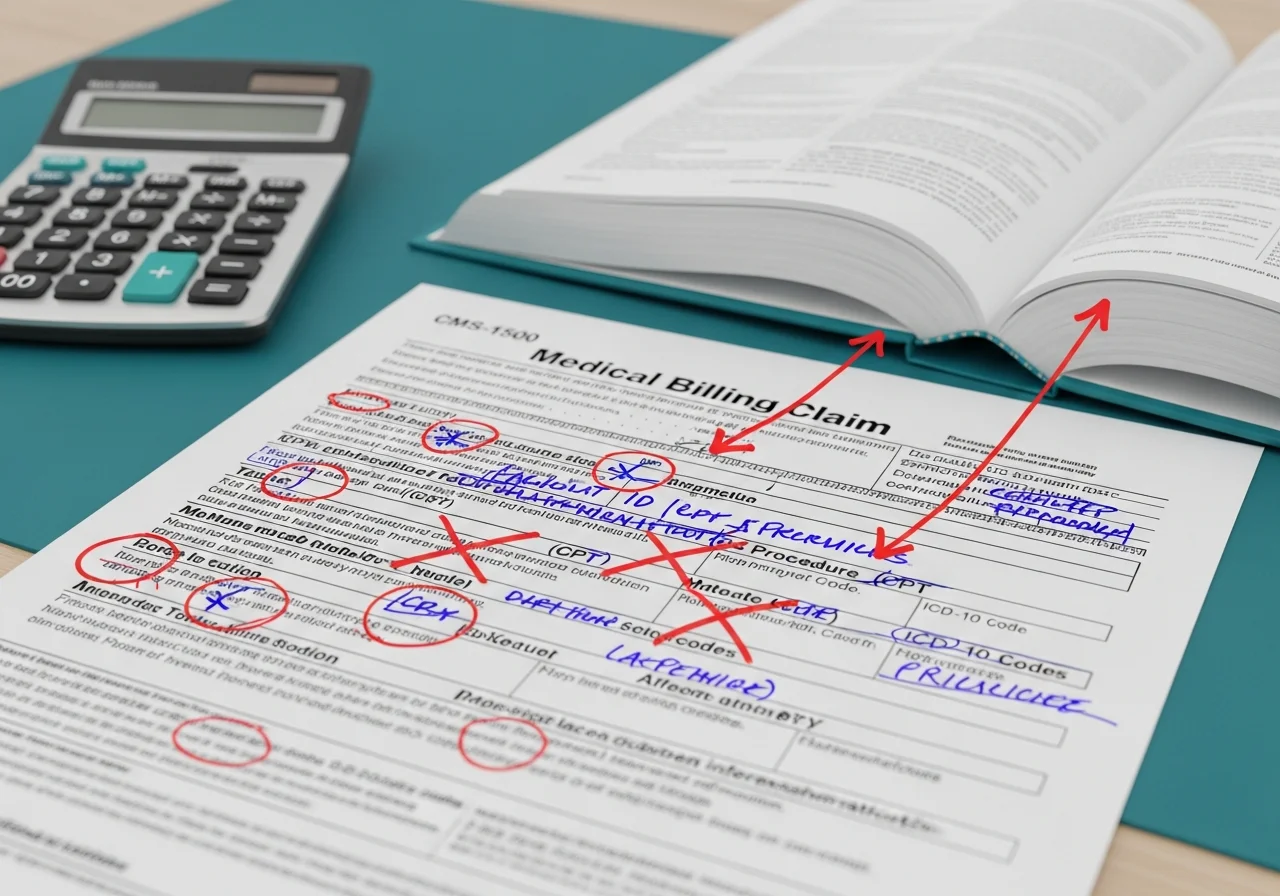
Common medical billing and coding errors account for a significant share of claim denials across U.S. healthcare practices. The most frequent mistakes include upcoding, undercoding, unbundling, incorrect modifier use, and data entry errors like wrong patient IDs. These errors cost practices revenue and can trigger compliance audits. Understanding the root causes and building quality-check workflows prevents most of them.
- 1.The most common coding errors include upcoding, undercoding, unbundling (billing separately for bundled procedures), incorrect modifier use, and misapplied diagnosis codes.
- 2.Data entry mistakes like wrong patient IDs, incorrect date of service, and missing insurance information cause a large share of easily preventable denials.
- 3.Documentation gaps are a root cause of many coding errors. If the provider's notes don't support the code, the claim will be denied or flagged for audit.
- 4.Building a pre-submission checklist and running claims through scrubbing software catches most errors before they reach the payer.
- 5.Staying current on annual ICD-10-CM (Oct 1) and CPT (Jan 1) code updates prevents outdated-code rejections.
5-10%
Average Claim Denial Rate
$25-$50
Avg Cost to Rework a Denied Claim
80%+
Target Clean Claim Rate
95%+
Expected Coding Accuracy
Coding Errors That Trigger Claim Denials
These are the coding-specific mistakes that cause the most problems. Each one results in either denied claims, reduced reimbursement, or compliance risk.
Upcoding. Assigning a higher-level code than the documentation supports. For example, billing a level 4 E/M visit (99214) when the provider's notes only support a level 3 (99213). Upcoding can be accidental (misreading documentation) or intentional (trying to increase revenue), but either way it's a compliance violation. Payers use automated edits to flag patterns of upcoding, and consistent upcoding can trigger a formal audit.
Undercoding. The opposite problem: assigning a lower code than what's documented. This is technically compliant but costs your employer money. Undercoding often happens when coders are unsure about a code and default to the safer, lower option. It's especially common with new coders who are cautious about overcoding.
Unbundling. Billing separately for procedures that should be billed as a single bundled code. The National Correct Coding Initiative (NCCI) maintains edit tables that define which procedure codes can and can't be billed together. Unbundling is one of the most common reasons for claim denials and can raise fraud flags if it happens repeatedly.
Incorrect modifier use. Modifiers tell payers that a procedure was altered in some way (different anatomical site, reduced service, distinct procedure). Using the wrong modifier, or forgetting one entirely, leads to denials. Modifier 25 (significant, separately identifiable E/M service) and modifier 59 (distinct procedural service) are among the most commonly misapplied.
Source: OIG audit reports
Billing and Data Entry Mistakes in Medical Billing and Coding
Many claim denials have nothing to do with coding accuracy. They're caused by basic data entry errors that are entirely preventable.
Wrong patient information. Misspelled names, incorrect dates of birth, wrong insurance ID numbers, and mismatched subscriber information cause immediate rejections. These errors happen most often during patient registration and check-in. A simple verification step (asking patients to confirm their information at each visit) prevents most of them.
Incorrect date of service. Billing for the wrong date is a straightforward error that triggers automatic denials. It's most common when batching claims for multiple dates of service or when there's a lag between the patient visit and claim entry.
Missing or expired authorization. Many procedures and specialist visits require prior authorization from the insurance company. If the authorization isn't obtained before the service, or if the auth number isn't included on the claim, the claim gets denied. Authorization tracking is a billing function that requires coordination between the front desk, providers, and billing staff.
Duplicate billing. Submitting the same claim twice, usually because the first submission didn't show as received in the clearinghouse. Payers automatically reject duplicates, but repeated duplicate submissions can flag your practice for unusual billing patterns.
The modifier you used doesn't match the procedure. Check NCCI edit tables and payer-specific modifier rules.
The claim is incomplete. Usually missing patient demographics, referring provider NPI, or authorization number.
Duplicate submission. The payer already processed this claim. Check your remittance records before resubmitting.
The diagnosis code doesn't support medical necessity for the procedure billed. Review documentation and coding guidelines.
Documentation Gaps and Provider Issues
You can't code what isn't documented. One of the most frustrating challenges for medical billers and coders is receiving incomplete or ambiguous documentation from providers.
Insufficient documentation for the code level. A provider may perform a comprehensive exam but only document a brief note. You can't assign a high-level E/M code based on what you assume happened. You can only code what's written in the medical record. This is where provider education and query processes become essential.
Missing linkage between diagnosis and procedure. Every procedure needs a diagnosis that establishes medical necessity. If a provider documents a knee X-ray but doesn't document the clinical reason (pain, injury, follow-up for fracture), the claim will be denied for lack of medical necessity. Coders should query the provider for clarification rather than guessing at the diagnosis.
Late or missing documentation. Claims have timely filing deadlines (typically 90 days to one year depending on the payer). When providers don't complete their notes promptly, the billing cycle stalls and claims risk hitting filing limits. Building documentation completion into the daily workflow prevents this.
Source: Industry standard
How to Prevent Medical Billing and Coding Errors
Use encoder and scrubbing software. Tools like 3M CodeFinder, Optum EncoderPro, and claim-scrubbing platforms (Waystar, Availity) catch bundling errors, modifier mismatches, and medical-necessity failures before claims reach the payer. Running every claim through a scrubber is the single most effective error-prevention step.
Build a pre-submission checklist. Before submitting any batch of claims, verify: patient demographics match, dates of service are correct, authorization numbers are included where required, diagnosis codes support the procedures billed, modifiers are applied correctly, and no duplicate claims are in the batch.
Stay current on code updates. ICD-10-CM codes update every October 1. CPT codes update every January 1. Using outdated codes is an easy way to generate denials. Set calendar reminders to review updates from CMS and the AMA, and attend your AAPC chapter's annual code-update workshops.
Maintain your continuing education. AAPC requires 36 CEUs every two years for CPC holders. AHIMA has similar requirements. These aren't just bureaucratic checkboxes. CEU activities keep you current on guideline changes, payer policy updates, and emerging compliance issues. Staying current is how you prevent errors before they happen.
Query providers, don't guess. If documentation is unclear or insufficient, send a coding query to the provider. Never assign a code based on assumptions about what was done or diagnosed. A compliant query process protects both you and the provider.
Source: AAPC.com
Technology That Reduces Medical Billing and Coding Errors
Modern billing offices rely on technology to catch errors before claims go out the door. Claim scrubbing software (Waystar, Availity, ClaimRemedi) automatically checks every claim against NCCI edits, LCD/NCD rules, and payer-specific requirements. These tools flag bundling issues, missing modifiers, and diagnosis-procedure mismatches in real time.
Encoder software (3M CodeFinder, Optum EncoderPro, TruCode) helps coders select accurate codes by providing guideline references, code descriptions, and cross-references during the coding process. Computer-assisted coding (CAC) tools are increasingly used to suggest codes based on clinical documentation, though human review remains required for accuracy.
AI-powered tools are expanding in this space, but they complement human coders rather than replacing them. The most effective error-reduction strategy combines technology (scrubbers, encoders) with human processes (audits, checklists, provider queries). For more on how AI is affecting medical coding, see our dedicated article.
Source: AAPC 2025 Salary Survey
Quality Assurance and Auditing Practices
Conduct internal audits regularly
Review a random sample of coded charts (5-10%) monthly. Compare your codes against a senior coder or auditor's assessment. Track accuracy rates over time.
Track denial patterns
Analyze your denial reports weekly. Look for recurring reasons (same error type, same payer, same procedure). Patterns point to systemic issues you can fix.
Build feedback loops with providers
Share coding audit results with providers. If one provider consistently under-documents, targeted education solves the problem at the source.
Use NCCI edit tables
CMS publishes NCCI edits quarterly. Check procedure code pairs against these tables before billing to avoid unbundling denials.
Keep a personal error log
Track your own mistakes and near-misses. Reviewing this log quarterly helps you identify your weak areas and target your continuing education accordingly.
Frequently Asked Questions
Latest Articles

Medical Billing and Coding Industry Trends 2026
AI-assisted coding, value-based care, and remote work are reshaping the medical coding profession.
CPC vs CCA: Which Certification?
Comparing AAPC and AHIMA entry-level certifications: cost, difficulty, employer preference, and career impact.

Can AI Replace Medical Coders?
What automation means for medical coders: which tasks are changing and which skills remain essential.

Angela R.
Medical Billing & Coding Specialist | Consultant
Angela worked as a medical billing and coding specialist for multiple chiropractors and orthopedic surgeons. After years in the field, she started her own medical billing and coding consulting company, working with numerous clients throughout Southern California. She brings firsthand industry experience to every article on this site.