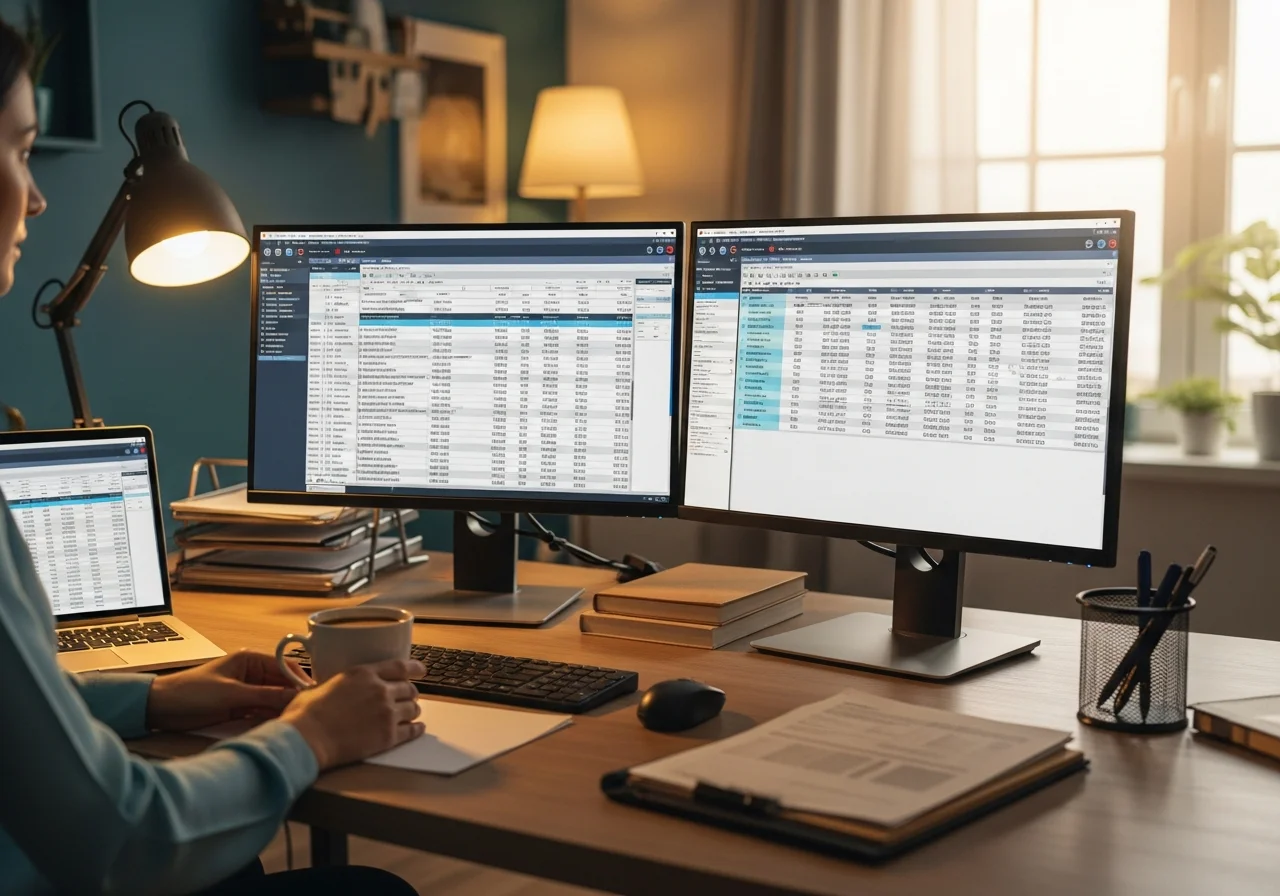
A day in the life of a medical billing and coding specialist revolves around reviewing patient charts, assigning ICD-10-CM and CPT codes, submitting claims to insurance payers, and resolving denials. Most coders handle 50 to 80+ charts per day depending on specialty and complexity. About 64.8% now do this work remotely at least part-time.
- 1.Medical billers and coders spend most of their day reviewing clinical documentation, assigning diagnosis and procedure codes, and submitting claims to insurance payers.
- 2.A typical coder processes 50 to 80+ charts per day in outpatient settings, fewer in complex inpatient or surgical specialties.
- 3.The job is almost entirely screen-based, which is why 64.8% of coders work remotely at least part-time (AAPC 2024 Survey).
- 4.Billers focus on the financial side: claim submission, payment posting, denial management, and patient billing. Coders focus on code accuracy. Many smaller offices combine both roles.
- 5.Daily tools include EHR systems (Epic, Cerner), encoder software (3M, Optum), and payer portals for claim status checks.
$50,250
Median Annual Salary
194,800
Total U.S. Jobs
7%
Job Growth (2023-2033)
64.8%
Work Remotely
Morning: Chart Review and Code Assignment
Your day typically starts between 7:30 and 9:00 a.m., depending on your employer and whether you're working on-site or from home. The first task is pulling up your coding queue, which is the list of patient charts waiting for code assignment. In most offices, charts flow into this queue automatically after providers complete their clinical documentation.
For each chart, you'll read the physician's notes, lab results, imaging reports, and any procedure documentation. Then you'll assign the correct ICD-10-CM diagnosis codes and CPT procedure codes based on what's documented. This step requires careful attention because the codes you select directly determine how much the practice gets paid. Undercoding leaves money on the table. Overcoding triggers audits and potential fraud allegations.
In an outpatient primary care office, you might process 60 to 80 charts in a morning because most visits involve straightforward E/M (Evaluation and Management) codes. In a surgical or specialty practice, you'll handle fewer charts because the documentation is more complex and often involves multiple procedure codes, modifiers, and bundling rules.
Source: Industry standard, varies by specialty
Midday: Claim Submission and Payer Follow-Up
Once codes are assigned, the billing side kicks in. If your office separates billing and coding roles, a biller picks up where you left off. If you handle both (common in smaller practices), you'll submit coded claims to insurance payers through a clearinghouse or directly through payer portals.
Before submission, claims go through a "scrubbing" process where software checks for common errors: mismatched diagnosis and procedure codes, missing modifiers, invalid patient demographics, and authorization gaps. You'll fix any flagged issues before sending the claim out. Clean claim rates matter because every rejected claim means rework and delayed payment.
You'll also spend time checking the status of previously submitted claims. Insurance companies don't always process claims quickly, and following up on pending claims is a routine part of the billing workflow. This involves logging into payer portals (UnitedHealthcare, Aetna, Blue Cross, Medicare) and tracking where each claim sits in the adjudication process.
Source: MGMA industry benchmark
Afternoon: Denials, Appeals, and Wrap-Up
The afternoon often involves denial management. When insurance companies reject or underpay claims, someone has to figure out why and fix it. Common denial reasons include incorrect patient information, coding errors, lack of prior authorization, and medical necessity disputes.
For simple denials (a typo in the patient ID, a missing modifier), you'll correct the claim and resubmit. For complex denials, you might need to write an appeal letter with supporting documentation from the provider. This is where strong knowledge of payer rules, coding guidelines, and clinical terminology all come together.
The last part of your day typically includes wrapping up any remaining charts in your queue, responding to queries from providers who need clarification on documentation requirements, and updating internal tracking spreadsheets or dashboards. Many offices hold brief end-of-day huddles to discuss coding questions, policy updates, or problematic claims.
Tools You'll Use Every Day in Medical Billing and Coding
Electronic Health Records (EHR). You'll spend most of your screen time in an EHR system. Epic and Cerner are the most common in hospitals and large health systems. Smaller practices often use AdvancedMD, athenahealth, Kareo, or DrChrono. The EHR is where you access patient charts, clinical notes, and documentation.
Encoder software. Tools like 3M CodeFinder, Optum EncoderPro, or TruCode help you look up codes, check bundling rules, verify medical necessity, and apply the correct modifiers. Most employers provide encoder access, and learning to use it efficiently is one of the fastest ways to increase your productivity.
Practice management and billing software. This is where claims get built, scrubbed, submitted, and tracked. Systems like Waystar, Availity, and Office Ally handle clearinghouse functions. You'll also log into individual payer portals (Medicare's MAC portals, commercial insurance sites) to check claim status and eligibility.
Source: AAPC 2025 Salary Survey
What Makes the Job Challenging
Constant guideline changes. ICD-10-CM, CPT, and HCPCS codes update every year. Payer-specific rules change even more often. You'll need to stay current with annual code updates (typically effective October 1 for ICD-10-CM and January 1 for CPT) and any mid-year revisions. This is why both AAPC and AHIMA require continuing education for certification maintenance.
Repetitive screen work. Coding is almost entirely computer-based. If you don't enjoy working at a screen for 7 to 8 hours, this role will feel draining. Experienced coders manage this by taking regular breaks, using ergonomic setups, and varying their tasks throughout the day.
Accuracy pressure. Coding errors can trigger claim denials (lost revenue), compliance audits, or even fraud investigations in extreme cases. Accuracy rates of 95% or higher are the standard expectation. Most employers track your accuracy and productivity metrics weekly or monthly.
Provider pushback. Occasionally, a provider's documentation doesn't support the code they want billed. You'll need to query the provider for clarification, which sometimes creates friction. Handling these conversations diplomatically, while protecting coding compliance, is a skill that develops with experience.
Source: BLS Occupational Outlook Handbook
International Classification of Diseases, 10th Revision. Used for diagnosis codes. Updated annually on October 1 by CMS.
Current Procedural Terminology. Used for procedure and service codes. Maintained by the AMA, updated January 1 annually.
Healthcare Common Procedure Coding System. Covers supplies, DME, drugs, and services not in CPT. Updated quarterly by CMS.
Two-digit codes appended to CPT/HCPCS codes to provide additional information (anatomical site, multiple procedures, reduced services).
Ready to Start Your Career?
Complete a training program
Most programs take 4 to 12 months. Online options offer flexibility for working adults.
Earn your certification
The CPC (AAPC) or CCA (AHIMA) are the most common starting credentials.
Build experience
Target physician offices, billing companies, or AAPC's Practicode program to gain verifiable coding experience.
Advance and specialize
After 1 to 2 years, pursue remote work, specialty coding, or management roles.
Frequently Asked Questions
Latest Articles

Medical Billing and Coding Industry Trends 2026
AI-assisted coding, value-based care, and remote work are reshaping the medical coding profession.
CPC vs CCA: Which Certification?
Comparing AAPC and AHIMA entry-level certifications: cost, difficulty, employer preference, and career impact.

Can AI Replace Medical Coders?
What automation means for medical coders: which tasks are changing and which skills remain essential.

Angela R.
Medical Billing & Coding Specialist | Consultant
Angela worked as a medical billing and coding specialist for multiple chiropractors and orthopedic surgeons. After years in the field, she started her own medical billing and coding consulting company, working with numerous clients throughout Southern California. She brings firsthand industry experience to every article on this site.