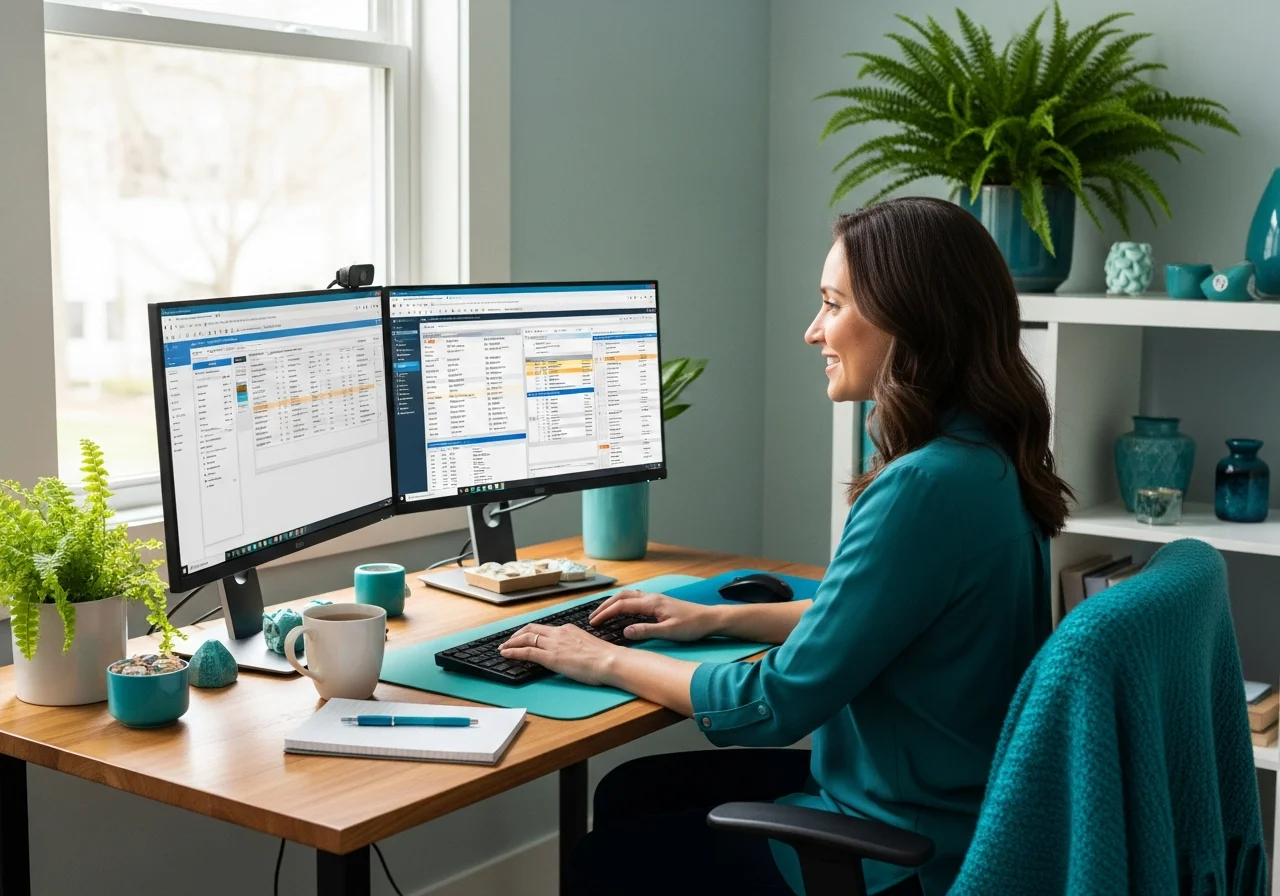
Medical billing and coding work from home is one of the most accessible remote healthcare careers. About 64.8% of medical coders now work remotely at least part-time, up from roughly 30% before 2020. Most employers require certification and 1 to 2 years of on-site experience before approving remote arrangements, though some entry-level remote positions exist.
- 1.About 64.8% of medical coders work remotely full-time, with another 14.1% in hybrid roles, so roughly 80% of the workforce has a remote component (AAPC 2024 Survey, 25,000+ respondents).
- 2.Most employers require at least 1 to 2 years of on-site coding experience before approving remote work, though some positions accept entry-level remote coders with strong credentials.
- 3.HIPAA compliance for home offices requires a dedicated private workspace, encrypted devices, VPN access, automatic screen lock, and no shared-access computers.
- 4.Top remote employers include Optum, Datavant, Aviacode/GeBBS, The Coding Network, and AGS Health.
- 5.Remote coders average $54,784/yr. The gap with the overall $66,979 certified average reflects experience levels, not a remote work penalty.
64.8%
Coders Working Remotely
$54,784
Avg Remote Coder Salary
1-2 yrs
Typical Experience Required
92%
Remote Coder Job Satisfaction
Remote Work in Medical Billing and Coding
Medical billing and coding work from home isn't a niche perk anymore. It's how most of the industry operates. According to AAPC's 2024 salary survey (25,000+ respondents), 64.8% of medical coders work remotely full-time and another 14.1% work hybrid schedules. That's roughly 80% of the workforce with at least some remote component.
This shift accelerated during the pandemic but it stuck because the work itself is screen-based. You're reviewing electronic health records, assigning diagnosis and procedure codes, and submitting claims through software. None of that requires physical presence in an office. Employers kept remote arrangements because productivity metrics held steady and office space costs dropped.
The BLS projects 7% employment growth for medical records specialists (SOC 29-2072) from 2023 to 2033, with about 14,200 annual openings. Combined with high remote availability, this makes medical billing and coding one of the most accessible work-from-home healthcare careers available.
Source: AAPC 2024 Salary Survey
Experience and Certification Requirements for Remote Medical Coding
Experience threshold. Most remote coding employers require 1 to 2 years of on-site coding experience before approving a remote arrangement. This is standard across Optum, Datavant, and most major health systems. Employers want coders who've demonstrated consistent accuracy and productivity under direct supervision before working independently from home.
Some employers do hire entry-level remote coders, particularly for outpatient E/M coding or high-volume specialties like radiology and pathology where coding patterns are more repetitive. These positions typically offer more supervision (virtual mentoring, coding quality reviews) and may start at lower pay scales.
Certification is non-negotiable. Virtually all remote coding positions require at least one professional certification. The most commonly accepted credentials are the CPC (AAPC), CCS (AHIMA), and CCA (AHIMA). Many job listings specify "CPC or CCS required" without accepting uncertified applicants, even those with experience.
Specialty experience helps. Remote positions in risk-adjustment (HCC) coding, surgical coding, and inpatient coding typically require specialty-specific experience beyond general outpatient work. These roles also pay more. Coding auditors and HCC specialists working remotely often earn $60,000 to $80,000+ depending on credentials. If you're planning a path to remote work, building specialty expertise during your on-site years significantly broadens your options.
The most widely held coding credential. Required for most outpatient remote roles. Exam: 100 questions, 4 hours, $425-$499.
Preferred for hospital and inpatient remote coding. Recognized across health systems. Exam: $399-$499.
Entry-level credential covering both outpatient and inpatient fundamentals. Lower cost at $199-$299.
Certified Risk Adjustment Coder. Specifically for HCC/risk-adjustment remote roles, which are among the highest-paying.
HIPAA-Compliant Home Office Setup
Working with protected health information (PHI) from home means your home office must meet HIPAA security and privacy requirements. Employers verify your setup before granting remote access, and violations can result in termination or federal penalties.
Dedicated private workspace. You need a room with a door that locks. Family members, roommates, and visitors can't see your screen or hear patient-related conversations. Some employers accept a private desk area with a privacy screen, but a separate room is strongly preferred.
Encrypted, employer-managed devices. Most employers provide company laptops with full-disk encryption, automatic screen lock (typically 2 to 5 minutes of inactivity), and remote-wipe capability. Personal computers generally aren't permitted for accessing PHI unless the employer has approved the device and installed their security software.
Secure network connection. You'll connect through a VPN (virtual private network). Your home internet needs to be reliable, usually 10 to 25 Mbps minimum download speed. Public Wi-Fi and shared networks aren't allowed for accessing PHI. Your home router should use WPA3 or WPA2 encryption with a strong, unique password.
No paper PHI. Remote coders shouldn't print patient records or keep paper files containing PHI at home. Most employers require a fully paperless workflow for remote coders.
Source: HHS HIPAA Security Rule
Top Employers Hiring Remote Medical Coders
Several large organizations consistently hire remote medical billers and coders across the country. These are among the most active remote-coding employers as of early 2026.
Optum (UnitedHealth Group) is one of the largest employers of remote coders in the U.S. They hire for outpatient, inpatient, HCC risk adjustment, and coding quality analyst roles. Pay ranges from about $23 to $42/hr depending on role and experience. Remote positions typically require CPC, CCS, or equivalent certification plus 1 to 2 years of experience.
Datavant (formerly Ciox Health) is a major health data and coding services company that hires remote coders for medical records review, coding, and auditing. Positions generally require certification and at least one year of coding experience.
Aviacode / GeBBS Healthcare Solutions hires remote coders for physician-practice and outpatient facility coding. They're known for being more willing to hire coders with less experience compared to larger companies, though certification is still required.
The Coding Network (TCN) contracts with physician practices and offers remote coding opportunities in multiple specialties. Coders operate as independent contractors, which provides scheduling flexibility but means no employer-provided benefits.
AGS Health provides revenue-cycle services including remote coding for hospital and physician coding roles, offering employee-status positions with benefits.
Productivity Tips for Remote Medical Billers and Coders
Maintaining consistent productivity is essential for keeping a remote position. Employers track charts-per-hour and accuracy rates, and falling below targets can mean losing your remote privileges. Here's what experienced remote coders recommend.
Work in focused blocks. Code in 50-minute sessions with 10-minute breaks. This prevents fatigue-related errors and keeps your accuracy rate high over a full shift. Set a timer if it helps.
Track your own metrics. Don't wait for your employer's monthly report. Track your charts-per-hour and accuracy rates weekly so you can spot trends and adjust before they become problems.
Keep references accessible. Whether you use digital codebooks or physical copies, your ICD-10-CM, CPT, and HCPCS references should be within arm's reach. Dual monitors are strongly recommended: one for the chart, one for coding software.
Set boundaries with household members. Establish clear working hours and communicate them. Interruptions break your concentration and slow down chart processing. This is also a HIPAA issue, as household members can't be in a position to view PHI on your screen.
Stay connected. Isolation is the most commonly cited challenge for remote coders. Attend virtual team meetings, participate in online coding forums, and join your local AAPC chapter. Proactive communication with your supervisor and peers prevents isolation from becoming a problem.
Source: AAPC 2024 Salary Survey
Your Path to Remote Medical Coding Work
Build 1-2 years of on-site experience
Target physician offices or billing companies. Focus on accuracy and productivity metrics.
Set up a HIPAA-compliant home office
Private room with a locking door, dual monitors, reliable internet (10-25 Mbps+), and a VPN-ready setup.
Apply to remote-friendly employers
Check Optum, Datavant, AAPC job board, and LinkedIn. Set up email alerts for remote coding positions.
Source: BLS, 2023-2033 projections
Frequently Asked Questions
Latest Articles

Medical Billing and Coding Industry Trends 2026
AI-assisted coding, value-based care, and remote work are reshaping the medical coding profession.
CPC vs CCA: Which Certification?
Comparing AAPC and AHIMA entry-level certifications: cost, difficulty, employer preference, and career impact.

Can AI Replace Medical Coders?
What automation means for medical coders: which tasks are changing and which skills remain essential.

Angela R.
Medical Billing & Coding Specialist | Consultant
Angela worked as a medical billing and coding specialist for multiple chiropractors and orthopedic surgeons. After years in the field, she started her own medical billing and coding consulting company, working with numerous clients throughout Southern California. She brings firsthand industry experience to every article on this site.