
Your medical billing and coding resume needs to do two things: pass ATS (applicant tracking system) filters and impress the human who reads it next. List your certification credentials (CPC, CCA, CCS, CBCS) right after your name, use keywords from the job posting, and quantify your impact with metrics like coding accuracy rates and charts processed per day. New graduates should lead with education and certifications, while experienced coders lead with achievements.
- 1.List your certification credentials (CPC, CPC-A, CCA, CBCS, CCS) immediately after your name in the resume header. This is the first thing hiring managers look for.
- 2.Use ATS-friendly keywords from the job posting: ICD-10-CM, CPT, HCPCS, HIPAA, revenue cycle, denial management, claims processing, and specific EHR system names.
- 3.Quantify your impact wherever possible: coding accuracy rates, charts processed per day, denial reduction percentages, and revenue recovered.
- 4.New graduates should lead with education and certifications, then list practicum experience, software skills, and any transferable skills from prior work.
- 5.Use a clean, single-column format with standard fonts. Avoid tables, text boxes, headers/footers, and graphics that break ATS parsing.
95%+
Accuracy Standard
$66,979
Certified Avg. Salary
20.7%
Cert Pay Premium
1-2 pg
Ideal Resume Length
Medical Billing and Coding Resume Structure and Format
Your medical billing and coding resume should use a reverse-chronological format, with your most recent experience or education listed first. This is the format employers expect and the one that ATS (applicant tracking system) software handles most reliably.
Keep the layout clean and simple. Use a single-column format with standard section headings (Summary, Certifications, Education, Experience, Skills). Avoid tables, text boxes, columns, headers, footers, and decorative graphics. All of these can break ATS parsing and cause your resume to be misread or rejected.
Use a standard font (Arial, Calibri, Times New Roman, or Garamond) at 10-12 points. Save as .docx for maximum ATS compatibility. PDF works if the employer doesn't specify a preference. One page for new graduates and coders with less than 5 years of experience. Two pages only if every additional line adds value.
Header and Credentials Placement
Put credentials after your name
Place your certification abbreviations directly after your name: "Jane Smith, CPC" or "John Doe, CPC-A, CBCS." This is standard practice in healthcare and immediately signals your qualifications.
Keep contact info compact
Below your name, include city and state (full street address isn't necessary), phone number, email address, and LinkedIn profile URL if you have one. Two to three lines maximum.
Write a focused professional summary
Follow the header with 3-4 sentences positioning yourself as a revenue cycle contributor. Example: "CPC-certified medical coding professional with training in ICD-10-CM, CPT, and HCPCS code systems. Completed 120-hour practicum at [facility] with 96% coding accuracy across 500+ outpatient encounters."
Source: AAPC 2025 Salary Survey
Medical Billing and Coding Resume for New Graduates (No Experience)
If you're a recent graduate with no professional coding experience, structure your resume to highlight education, certification, and any practical training. This is the format that works best when you don't have job history in the field yet.
1. Professional Summary. Two to three sentences describing your certification, training focus, and career goal. Mention specific code sets and any practicum experience.
2. Certifications. List each credential with the issuing organization and date earned. For CPC-A holders, list it as "CPC-A (Certified Professional Coder, Apprentice), AAPC, [date]." Don't try to hide the apprentice designation. It's expected.
3. Education. Include your training program name, institution, completion date, and any relevant coursework or honors. If your program was accredited (CAHIIM, AAPC-approved, AHIMA-approved), note that. If you completed a practicum, list the facility name, hours completed, and any measurable outcomes (charts coded, accuracy rate).
4. Technical Skills. Create a concise skills section listing code sets (ICD-10-CM, CPT, HCPCS Level II), EHR systems you've used or trained on (Epic, Cerner, Meditech), encoder software (3M, Optum360, TruCode, Codify), and Microsoft Office proficiency.
5. Prior Work Experience. If you have work history in other fields, include it but frame it in terms relevant to coding and billing. Data entry speed, insurance claim processing, customer service, healthcare administration, and attention to detail in any context are all transferable. See our entry-level jobs guide for what employers look for.
2-3 sentences with your certification name, code set knowledge, and career goal. Mention your practicum if you completed one.
CPC-A, CCA, CBCS, or other credentials with issuing body and date. Don't bury these at the bottom.
Program name, institution, completion date, accreditation status. Practicum details with facility, hours, and accuracy rate.
ICD-10-CM, CPT, HCPCS, EHR systems (Epic, Cerner), encoder software (3M, Codify), Microsoft Office.
Frame previous jobs in terms of transferable skills: data accuracy, insurance knowledge, customer service, healthcare admin.
Resume for Experienced Medical Billing and Coding Professionals
If you have 2+ years of coding or billing experience, your resume should shift emphasis from education to professional achievements. Lead with your experience section and use bullet points that demonstrate measurable impact.
Quantify everything you can. "Coded an average of 25 outpatient charts per day with 97% accuracy" is far stronger than "Responsible for outpatient coding." Other metrics to include: denial rates for claims you coded, revenue recovered through appeals, audits passed without findings, and number of specialties covered.
Highlight specialty knowledge. If you work in a specific area, like risk adjustment, surgical coding, E/M, or emergency department, make that clear in your job title, summary, and bullet points. Specialty expertise is a premium differentiator, especially for remote positions. See our specializations guide for career track details.
List your credential stack prominently. If you hold multiple certifications (CPC + CRC, CCS + CPMA), list them all after your name and in a dedicated Certifications section. AAPC data shows professionals with two certifications average $74,557 per year, and those with three or more average $81,227.
Source: AAPC 2025 Salary Survey
ATS Keywords for Your Medical Billing and Coding Resume
Most healthcare employers use ATS software to screen resumes before a human reads them. To pass this initial filter, your medical billing and coding resume must contain the keywords the system is looking for. Here are the most important terms to include.
Code systems: ICD-10-CM, ICD-10-PCS, CPT, HCPCS, HCPCS Level II, DRG, APR-DRG, MS-DRG, HCC, APC.
Compliance and regulations: HIPAA, CMS, OIG, NCCI edits, medical necessity, compliance, coding guidelines, audit.
Revenue cycle terms: revenue cycle management, claim submission, denial management, claims processing, accounts receivable, payment posting, charge capture, charge entry, appeals, ERA, EOB, remittance.
Software: Epic, Cerner, Oracle Health, Meditech, 3M, Optum360, EncoderPro, TruCode, Codify, Availity, Change Healthcare, athenahealth, eClinicalWorks, Kareo.
The most effective approach is to read each job posting carefully and mirror its language. If a posting says "ICD-10-CM" rather than "ICD-10," use the full term. If it mentions specific software ("Epic experience required"), include that exact software name.
ATS Keyword Categories for Medical Billing and Coding Resumes
| Category | Must-Have Keywords | Nice-to-Have Keywords |
|---|---|---|
| Code Systems | ICD-10-CM, CPT, HCPCS | ICD-10-PCS, DRG, HCC, APC |
| Certifications | CPC, CCA, CCS, CBCS (whichever you hold) | CPB, CRC, CPMA, CIC, COC |
| Compliance | HIPAA, CMS, coding guidelines | NCCI edits, OIG, medical necessity |
| Revenue Cycle | Claims processing, denial management, payment posting | Charge capture, ERA, EOB, appeals |
| Software | Epic, Cerner (match the job posting) | 3M, Optum360, Codify, Availity |
| Soft Skills | Attention to detail, accuracy | Time management, analytical thinking |
Translating Transferable Skills
Career changers often underestimate how relevant their prior experience is. Here's how to translate common backgrounds into medical billing and coding resume language.
Insurance or claims background: You already understand payer processes, claim adjudication, and denial resolution. Emphasize your knowledge of insurance workflows, attention to accuracy, and experience with high-volume processing.
Data entry or administrative work: Speed, accuracy, and comfort with software systems transfer directly. Quantify your typing speed and error rate if possible. Data entry experience demonstrates the focus required for production coding.
Healthcare administration or front-office work: If you've worked in patient registration, scheduling, or insurance verification, you already understand the front end of the revenue cycle. This context helps you understand the full billing workflow.
Accounting or finance: Billing work involves financial reconciliation, accounts receivable management, and payment analysis. Accounting skills translate well into the financial side of medical billing.
Source: AAPC hiring manager survey data
Common Medical Billing and Coding Resume Mistakes
Burying your certification. Your credential should be in your name line, not hidden at the bottom of the page. Hiring managers scan resumes quickly. Make your CPC, CCS, or CCA impossible to miss.
Using vague bullet points. "Performed medical coding duties" tells the reader nothing. Instead, specify what you coded (outpatient E/M, surgical, inpatient), how much (volume per day), and how well (accuracy rate, denial rate).
Listing duties instead of accomplishments. "Responsible for coding patient charts" is a duty. "Maintained 97% first-pass coding accuracy across 25+ daily outpatient encounters, contributing to a 12% reduction in claim denials" is an accomplishment.
Using creative formatting. Infographic resumes, colored sidebars, and multi-column layouts may look appealing but often fail ATS parsing. Stick to a clean, single-column layout with standard section headings.
Omitting software skills. If you know Epic, Cerner, 3M encoder, or any specific practice management system, list it explicitly. Many job postings filter for specific software experience.
Source: AAPC 2025 Salary Survey
Should You Include a Cover Letter?
Yes, if the application allows it. A cover letter lets you explain why you're interested in that specific employer, address any gaps (like being a career changer or a new graduate with no experience), and highlight your strongest qualifications in a more conversational format.
Keep it to one page and tailor it to the specific position. Mention the exact job title and location, reference a specific detail about the employer (their EHR system, patient population, or reputation), and connect your skills directly to their needs. Don't just repeat your resume in paragraph form. For interview preparation, see our interview prep guide.
Frequently Asked Questions
Latest Articles

Medical Billing and Coding Industry Trends 2026
AI-assisted coding, value-based care, and remote work are reshaping the medical coding profession.
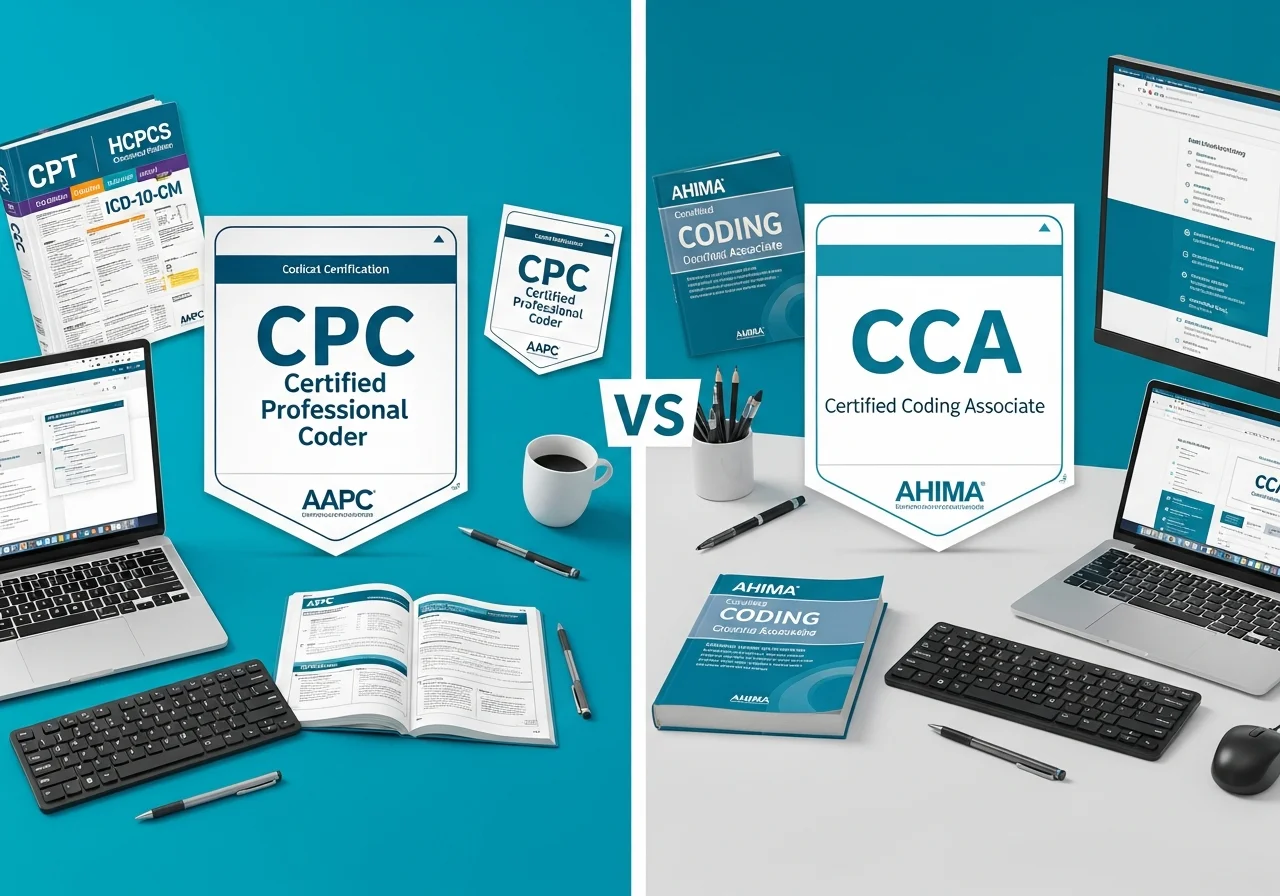
CPC vs CCA: Which Certification?
Comparing AAPC and AHIMA entry-level certifications: cost, difficulty, employer preference, and career impact.

Can AI Replace Medical Coders?
What automation means for medical coders: which tasks are changing and which skills remain essential.

Angela R.
Medical Billing & Coding Specialist | Consultant
Angela worked as a medical billing and coding specialist for multiple chiropractors and orthopedic surgeons. After years in the field, she started her own medical billing and coding consulting company, working with numerous clients throughout Southern California. She brings firsthand industry experience to every article on this site.