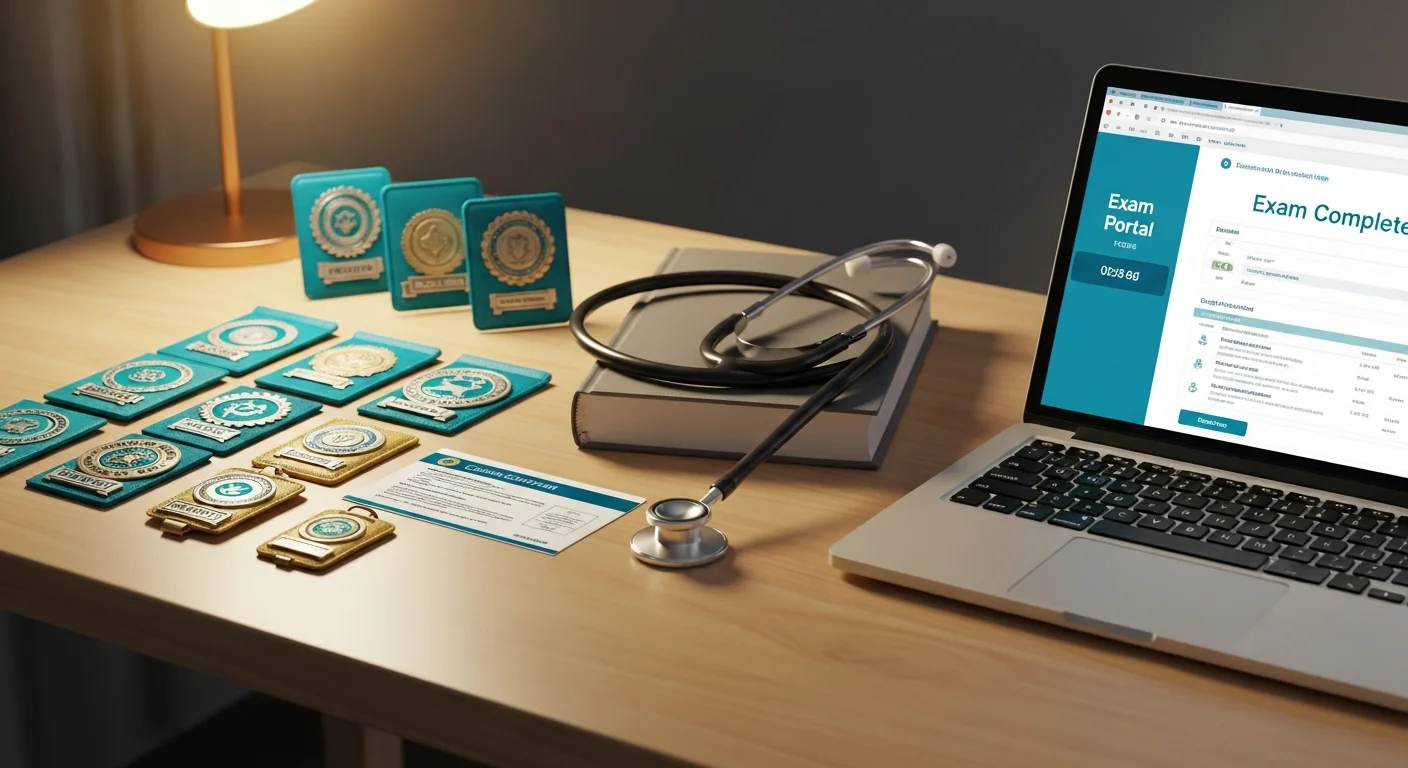
Medical billing and coding certification isn't legally required in most states, but it's a practical hiring standard. Five credentials matter most: CPC, CCA, CBCS, CCS, and CPB. Certified professionals earn an average of $66,979, which is 20.7% more than the $55,721 uncertified average. Exam costs range from $117 (CBCS) to $425 (CPC/CPB), and professionals with three or more credentials average $81,227 per year.
- 1.Five medical billing and coding certifications account for nearly all industry credentials: CPC (AAPC), CCA (AHIMA), CBCS (NHA), CCS (AHIMA), and CPB (AAPC).
- 2.Certified professionals earn $66,979 on average, 20.7% more than uncertified peers at $55,721 (AAPC, 2025 Salary Survey).
- 3.Holding three or more credentials pushes your average to $81,227 per year (AAPC, 2025 Salary Survey).
- 4.Exam costs range from roughly $117 for the CBCS to $425 for the CPC and CPB, not counting membership fees.
- 5.Your best certification depends on your focus: outpatient coding (CPC), entry-level coding (CCA), billing (CPB), hospital coding (CCS), or combined billing and coding on a budget (CBCS).
$66,979
Certified Avg. Salary
AAPC 2025 Survey
20.7%
Certification Premium
vs. uncertified peers
$81,227
3+ Credentials Avg.
AAPC 2025 Survey
~$117
Lowest Exam Cost
CBCS (NHA)
Why Medical Billing and Coding Certification Matters
Medical billing and coding certification isn't legally required in most states, but it's become a de facto hiring standard. Employers use credentials to verify that you understand coding systems (ICD-10-CM, CPT, HCPCS), billing regulations, and compliance requirements. In practice, most job postings for medical coders and billers list at least one certification as preferred or required.
The financial case is straightforward. According to the 2025 AAPC Salary Survey, certified professionals earn an average of $66,979 per year, while uncertified peers average $55,721. That's a gap of over $11,000 annually, and it grows with each additional credential.
Beyond salary, certification signals competence to employers and reduces onboarding time. Certified coders produce fewer claim denials caused by coding errors, which directly affects a healthcare organization's revenue. The credential also gives you geographic mobility. A CPC or CCA is recognized nationwide, making it easier to relocate or transition to remote work.
Source: AAPC 2025 Salary Survey
The Five Major Medical Billing and Coding Certifications
Three organizations issue the credentials that matter most: the American Academy of Professional Coders (AAPC), the American Health Information Management Association (AHIMA), and the National Healthcareer Association (NHA). Each takes a different approach to exam design and credentialing.
AAPC's flagship credential and the most widely held medical coding certification in the U.S. The CPC focuses on outpatient and physician-office coding using CPT, ICD-10-CM, and HCPCS Level II. Exam: 100 questions, 4 hours, open codebook. Cost: $425 (one attempt) or $499 (two attempts), plus AAPC membership at $222/year.
Key Points
- CPT coding
- ICD-10-CM
- E/M services
- Outpatient surgery coding
Common Jobs
- • Physician office coder
- • Outpatient coder
- • Remote medical coder
AHIMA's entry-level coding credential. Covers both inpatient and outpatient coding concepts, giving you a broader foundational knowledge base than outpatient-only certifications. Exam: 105 questions (15 unscored), 2 hours, open codebook. Cost: $199 (AHIMA members) or $299 (non-members).
Key Points
- ICD-10-CM
- ICD-10-PCS
- CPT basics
- Health information management
Common Jobs
- • Entry-level coder
- • Hospital HIM department
- • Billing company coder
NHA's combined billing and coding credential and the most affordable entry point at roughly $117. Covers ICD-10, CPT, HCPCS, medical terminology, insurance claims, and compliance. Exam: 100 scored questions plus 20 pretest items, passing score of 390.
Key Points
- Medical billing
- Insurance claims
- ICD-10/CPT basics
- Compliance
Common Jobs
- • Medical biller
- • Billing and coding specialist
- • Claims processor
AHIMA's advanced credential for hospital and inpatient coding. Tests complex scenarios involving ICD-10-PCS, DRGs, and case-level documentation. Exam: 107 questions (10 unscored), 4 hours, includes case studies. Cost: $299 (AHIMA members) or $399 (non-members). Recommends 1-2 years of coding experience.
Key Points
- Inpatient coding
- ICD-10-PCS
- DRG assignment
- Clinical documentation
Common Jobs
- • Hospital coder
- • Inpatient coding specialist
- • Coding auditor
AAPC's billing-focused credential. Tests billing regulations, claims processing, denial management, payer contracts, and revenue cycle knowledge rather than code assignment. Exam: 135 questions, 4 hours, open book. Cost: $425 (one attempt) or $499 (two attempts). Pairs well with the CPC.
Key Points
- Claims processing
- Denial management
- Revenue cycle
- Payer contracts
Common Jobs
- • Medical biller
- • Revenue cycle analyst
- • Billing manager
Quick Comparison: All Five Certifications
| Feature | CPC | CCA | CBCS | CCS | CPB |
|---|---|---|---|---|---|
| Issuing Body | AAPC | AHIMA | NHA | AHIMA | AAPC |
| Exam Cost | $425 (1 attempt) | $199-$299 | ~$117 | $299-$399 | $425 (1 attempt) |
| Questions | 100 | 105 (15 unscored) | 100 + 20 pretest | 107 (10 unscored) | 135 |
| Time Limit | 4 hours | 2 hours | Varies | 4 hours | 4 hours |
| Passing Score | 70% | 300 (scaled) | 390 (scaled) | 300 (scaled) | 70% |
| Open Book? | Yes | Yes (codebooks) | No | Yes (codebooks) | Yes |
| Focus | Outpatient coding | Entry-level coding | Billing & coding | Hospital coding | Billing & revenue cycle |
| Renewal Cycle | 2 yrs / 36 CEUs | 2 yrs / 20 CEUs | 2 yrs / 10 CEs | 2 yrs / 20 CEUs | 2 yrs / 36 CEUs |
| Best For | Physician office coders | Career starters | Budget-conscious entrants | Hospital coders | Billing specialists |
| Median Salary | $58,895 | N/A (AHIMA) | N/A (NHA) | N/A (AHIMA) | $56,981 |
Source: AAPC, AHIMA, NHA (2025)
How to Choose Your Medical Billing and Coding Certification
The right credential depends on three factors: your career goal, your budget, and your current experience level.
If you want to code in a physician's office or outpatient setting, the CPC is the industry standard. It's the most recognized credential among physician-practice employers and is often listed as a requirement in job postings. CPC holders report a median salary of $58,895 (AAPC, 2025).
If you're new to the field and want an affordable entry point, the CCA provides a nationally recognized AHIMA credential with minimal prerequisites. It's designed as a starting point, and many CCA holders later pursue the CCS or CPC.
If cost is your primary concern, the CBCS from NHA costs roughly one-quarter of what the CPC costs. It covers both billing and coding, making it a practical choice for career changers on a tight budget.
If you want to work in a hospital, the CCS is the credential hospital coding managers look for. It tests complex inpatient coding scenarios involving ICD-10-PCS, DRGs, and case-level documentation that outpatient-focused exams don't cover.
If your focus is billing rather than coding, the CPB is the only credential dedicated to claims processing, denial management, and revenue cycle operations. Billing-focused roles at large health systems and third-party billing companies favor this credential.
Source: BLS OEWS, May 2024
Salary Impact of Medical Billing and Coding Certification
The 2025 AAPC Salary Survey provides clear evidence that certification pays. Certified professionals earn $66,979 on average compared to $55,721 for uncertified workers. That's a 20.7% premium just for holding one credential.
The premium compounds with additional certifications. Professionals holding two credentials average $71,130, and those with three or more average $81,227 per year. CPC holders specifically report a median salary of $58,895, while CPB holders report $56,981 (AAPC, 2025).
The BLS reports a national median of $50,250 for medical records specialists (SOC 29-2072) as of May 2024, but this includes uncertified workers. The AAPC data suggests certified professionals significantly outperform that median. For more detail on earning potential, see our salary guide.
Stacking Multiple Credentials
Start with one credential that matches your immediate goal
Pick the CPC for outpatient coding, CCA for a budget-friendly AHIMA credential, or CBCS if cost is your top concern. Complete a training program and pass your first exam.
Build 1-2 years of work experience
Employers value experience alongside credentials. Use your first certification to land a job, then gain hands-on coding or billing practice.
Add a complementary second credential
Common pairings: CPC + CPB (coding and billing), CCA then CCS (entry to advanced hospital coding), or CPC + CCS (outpatient and inpatient). Two certifications average $71,130/year (AAPC, 2025).
Consider a third credential for maximum earning potential
Professionals with three or more certifications average $81,227/year. Some combine an AAPC credential (CPC) with an AHIMA credential (CCS) to show proficiency across both systems.
Source: AAPC 2025 Salary Survey
Renewal Requirements at a Glance
Every credential requires renewal every two years. Keep in mind that each active certification carries its own continuing education requirements and fees. If you hold credentials from multiple organizations, you'll need to plan your CE budget accordingly.
- CPC and CPB (AAPC): 36 CEUs per cycle, at least 24 in core coding topics. Active AAPC membership required.
- CCA and CCS (AHIMA): 20 CEUs per cycle, at least 80% in health information topics. Recertification fee: $100 (members) or $218 (non-members).
- CBCS (NHA): 10 continuing education credits per cycle.
Explore Each Certification
Frequently Asked Questions
Sources
Self-reported salary data from AAPC members
OEWS May 2024, SOC 29-2072
Exam format, costs, eligibility
CCA and CCS exam details
CBCS exam format and costs
Latest Articles

Medical Billing and Coding Industry Trends 2026
AI-assisted coding, value-based care, and remote work are reshaping the medical coding profession.
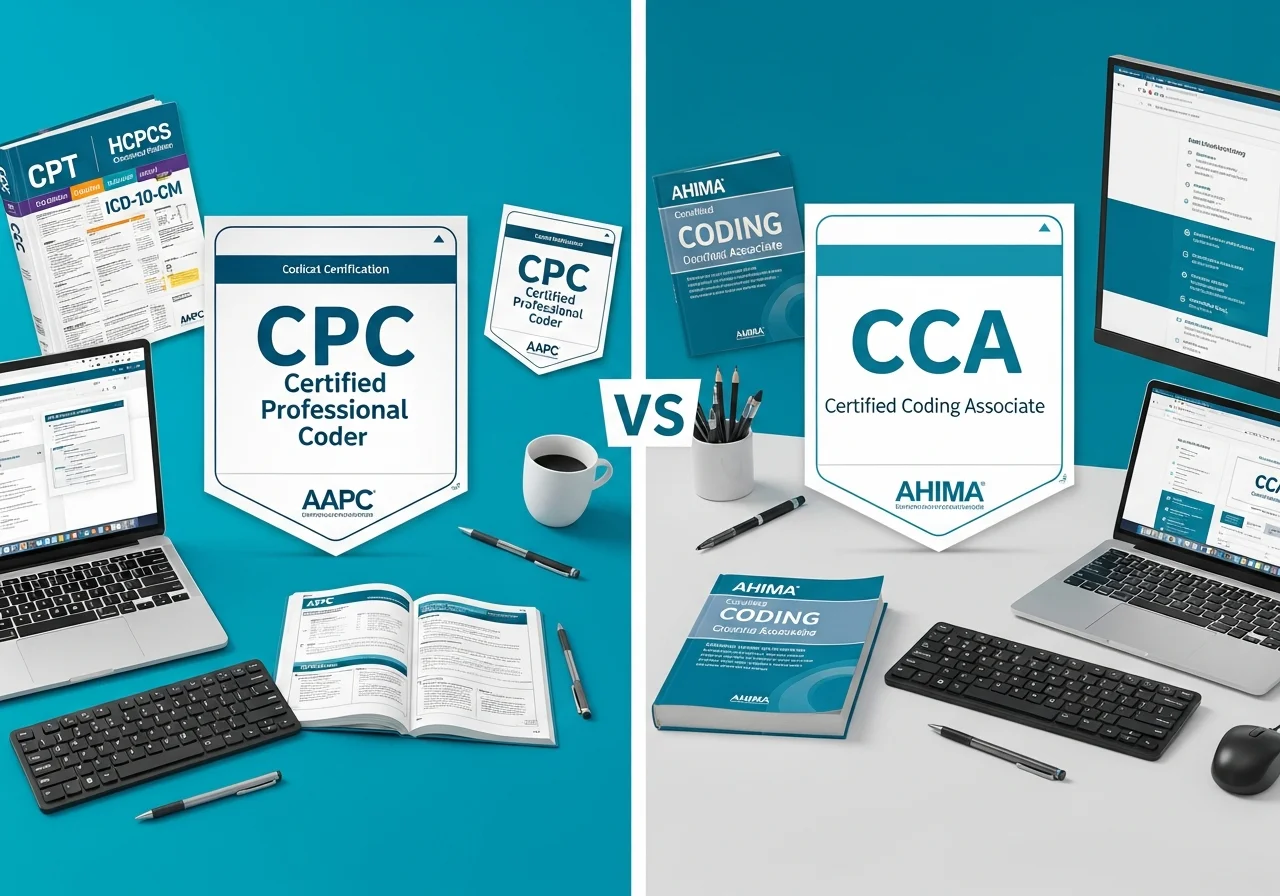
CPC vs CCA: Which Certification?
Comparing AAPC and AHIMA entry-level certifications: cost, difficulty, employer preference, and career impact.

Can AI Replace Medical Coders?
What automation means for medical coders: which tasks are changing and which skills remain essential.

Angela R.
Medical Billing & Coding Specialist | Consultant
Angela worked as a medical billing and coding specialist for multiple chiropractors and orthopedic surgeons. After years in the field, she started her own medical billing and coding consulting company, working with numerous clients throughout Southern California. She brings firsthand industry experience to every article on this site.