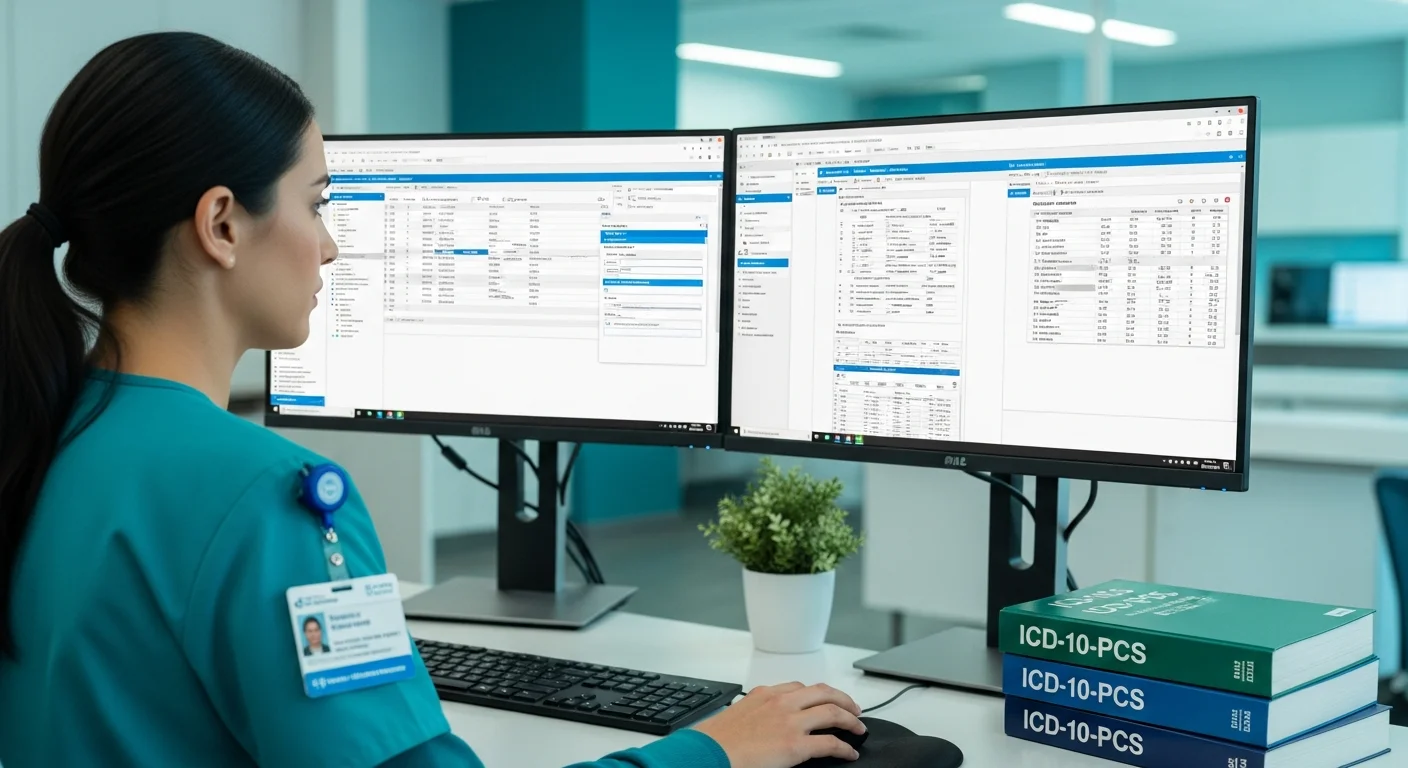
The CCS certification from AHIMA is the most respected credential for hospital-based medical coding positions. The exam costs $299 for AHIMA members or $399 for non-members and includes 107 questions with medical scenarios that simulate real inpatient and outpatient coding cases. You'll have 4 hours to complete it at a Pearson VUE testing center with your code books. Medical records specialists earn a median of $50,250 per year, and CCS holders in hospital settings typically earn above that figure.
- 1.The CCS is issued by AHIMA and is considered the gold standard for hospital-based medical coding positions.
- 2.The exam costs $299 for AHIMA members and $399 for non-members.
- 3.Format: 107 questions (97 scored, 10 pretest), 4-hour time limit, open-codebook at Pearson VUE testing centers.
- 4.The exam includes medical scenarios that simulate real inpatient and outpatient coding cases.
- 5.A passing score is 300 on AHIMA's scaled scoring system.
- 6.You'll need coding experience or a prior coding credential (like the CCA) plus one year of experience to qualify.
$299-$399
Exam Fee
Member vs. non-member
107
Total Questions
97 scored + 10 pretest
4 Hours
Time Limit
Open-codebook format
$50,250
Median Salary
BLS May 2024 (SOC 29-2072)
20 CEUs
Renewal
Every 2 years
300
Passing Score
AHIMA scaled scoring
What Is the CCS Certification?
The CCS (Certified Coding Specialist) is an advanced medical coding credential from the American Health Information Management Association (AHIMA). It validates your expertise in assigning codes for complex inpatient and outpatient medical records, including surgical procedures, diagnostic workups, and multi-system disease processes.
AHIMA positions the CCS as its mastery-level coding certification, a step above the entry-level CCA. CCS holders specialize in the coding systems hospitals rely on, particularly ICD-10-CM for diagnoses and ICD-10-PCS for inpatient procedures.
Hospitals, health systems, and coding consultancies recognize the CCS as proof that a coder can handle complex case coding, DRG assignment, and the documentation requirements that drive hospital reimbursement from Medicare, Medicaid, and commercial payers.
Source: AHIMA, 2025
CCS Exam Format and Structure
The CCS exam has 107 questions (97 scored and 10 unscored pretest items) with a 4-hour time limit. You'll need a passing score of 300 on AHIMA's scaled scoring system (AHIMA).
The exam is administered at Pearson VUE testing centers. Unlike the CCA, the CCS lets you move between questions and flag items for review, which is important given the complexity of the medical scenarios (AHIMA).
You'll need to bring your current-year code books to the testing center. Exams before May 1, 2026, require 2025 editions; exams on or after May 1, 2026, require 2026 editions. If you don't bring the correct books, you forfeit your exam fees (AHIMA).
CCS Certification Cost Breakdown
| Fee Type | AHIMA Member | Non-Member |
|---|---|---|
| Exam Fee | $299 | $399 |
| Retake Fee | $299 | $399 |
| Recertification (Every 2 Years) | $100 | $218 (increasing to $249 on March 1, 2026) |
| Dual Credential Recertification (CCA + CCS) | $120 | $256 |
| Code Books (Not Included) | $200-$400+ | $200-$400+ |
Source: AHIMA, 2025
Eligibility Requirements
The CCS is an advanced credential, so AHIMA requires you to demonstrate formal education or professional experience before sitting for the exam. You'll need to meet one of these pathways (AHIMA):
1. Coursework plus one year of experience: Complete coursework in anatomy, pathophysiology, pharmacology, medical terminology, reimbursement methodology, ICD coding, and CPT/HCPCS coding, plus at least one year of coding experience.
2. Two years of coding experience: A minimum of two years directly applying diagnosis and procedure codes.
3. CCA credential plus one year of experience: Hold AHIMA's CCA plus at least one year of coding experience.
4. Another coding credential plus one year of experience: Hold a coding certification from another body (like AAPC's CPC) plus one year of experience.
5. Hold CCS-P, RHIT, or RHIA credentials: If you already hold one of AHIMA's other health information credentials, you're eligible without additional experience.
Applying official coding guidelines, selecting principal and secondary diagnoses, understanding sequencing rules, and coding complications and comorbidities from clinical documentation.
Assigning seven-character procedure codes for inpatient hospital services, including surgical, medical/surgical-related, and ancillary procedures.
Coding outpatient hospital services, ambulatory surgery, facility-based physician services, E/M services, and HCPCS supply codes.
Multi-part case studies presenting real-world records (discharge summaries, operative reports) that require you to assign the correct combination of diagnosis and procedure codes.
DRG (Diagnosis-Related Group) assignment, medical necessity, coding for quality reporting, and compliance with Medicare coding guidelines.
What the CCS Exam Covers
The CCS exam tests advanced coding skills with a strong emphasis on hospital-based coding. The five major domains are ICD-10-CM diagnosis coding, ICD-10-PCS procedure coding, CPT/HCPCS Level II, medical scenarios (case studies), and reimbursement and compliance (AHIMA).
The medical scenarios are what separate the CCS from every other coding certification. You'll read full medical records, including discharge summaries and operative reports, and assign the correct combination of diagnosis and procedure codes. AHIMA's prep materials reference 28 of these scenarios.
Study Tips and CCS Exam Preparation
Master ICD-10-PCS first
If you've been coding mainly in outpatient settings, ICD-10-PCS will demand the most study time. The seven-character structure, root operations, and body system classification require dedicated practice.
Work through medical scenarios systematically
AHIMA's CCS prep materials include practice scenarios that mirror the exam. Read the full medical record before attempting to assign codes. Don't jump to coding without understanding the full clinical picture.
Tab your code books extensively
With 107 questions in 4 hours (including complex scenarios), efficient navigation is critical. Create tabs for ICD-10-CM guidelines, ICD-10-PCS tables, and CPT surgical sections.
Study DRG assignment
Understand how diagnosis and procedure codes drive DRG grouping. Focus on how CC (complication/comorbidity) and MCC (major complication/comorbidity) designations affect DRG assignment and reimbursement.
Review pharmacology basics
Unlike entry-level exams, the CCS expects familiarity with medication classes and their clinical implications. Knowing that vancomycin indicates a serious infection, or heparin indicates anticoagulation, helps with accurate code assignment.
Plan for 4 to 6 months of study
The CCS is widely considered the most challenging coding certification. Even experienced coders typically spend 4 to 6 months preparing.
Source: AHIMA, 2025
Maintaining Your CCS Certification
Your CCS must be renewed every two years. That means 20 continuing education units (CEUs) submitted within each cycle (AHIMA). At least 80% (16 CEUs) must come from Health Information and Informatics Management (HIIM) domain topics. The remaining 20% (4 CEUs) can come from broader healthcare or professional development topics.
As of January 2025, AHIMA requires that at least 40% of your CEUs come from AHIMA-approved sources, including AHIMA products, HCPro services, component state associations, and AHIMA-certified trainers (AHIMA).
Recertification costs $100 for AHIMA members or $218 for non-members (increasing to $249 on March 1, 2026). If you hold both the CCA and CCS, you'll need 30 total CEUs (20 for the first credential plus 10 for each additional) and pay $120 for members (AHIMA).
Source: BLS OEWS, May 2024
Career Impact and Salary Data
The CCS is the most respected coding credential for hospital positions. It qualifies you for senior coding roles, coding auditor positions, coding supervisor jobs, and consulting work in hospital compliance and revenue integrity.
According to the Bureau of Labor Statistics, medical records specialists (SOC 29-2072) earn a median annual salary of $50,250 as of May 2024, with projected growth of 7% from 2023 to 2033 and roughly 14,200 annual openings (BLS). The AAPC 2025 Salary Survey found that certified professionals average $66,979, and those with 3 or more credentials average $81,227.
The CCS also qualifies you for clinical documentation improvement (CDI) analyst and coding quality auditor roles, which typically pay more than general coding positions. For professionals who started with the CCA, earning the CCS is a clear career advancement step.
Frequently Asked Questions
Related Certification Guides
Latest Articles

Medical Billing and Coding Industry Trends 2026
AI-assisted coding, value-based care, and remote work are reshaping the medical coding profession.
CPC vs CCA: Which Certification?
Comparing AAPC and AHIMA entry-level certifications: cost, difficulty, employer preference, and career impact.

Can AI Replace Medical Coders?
What automation means for medical coders: which tasks are changing and which skills remain essential.

Angela R.
Medical Billing & Coding Specialist | Consultant
Angela worked as a medical billing and coding specialist for multiple chiropractors and orthopedic surgeons. After years in the field, she started her own medical billing and coding consulting company, working with numerous clients throughout Southern California. She brings firsthand industry experience to every article on this site.