Most people complete medical billing and coding training in 4 to 15 months through a certificate program, or about 2 years with an associate degree. Add 3 to 6 months for certification exam prep. Self-paced online programs from providers like Penn Foster let you finish faster if you study full-time.
- 1.How long does medical billing and coding take? Certificate programs run 4 to 15 months depending on full-time or part-time enrollment. This is the fastest path to a job.
- 2.Associate degree programs take about 2 years and include general education courses alongside medical billing and coding classes.
- 3.After finishing your program, plan on 3 to 6 more months to prepare for a certification exam (CPC, CCA, or CBCS).
- 4.Self-paced online medical billing and coding programs offer the most flexibility. Some students finish in 4 months; others take over a year.
- 5.Total timeline from enrollment to passing your certification and landing a job: typically 8 to 24 months.
4-15 mo
Certificate Programs
~2 years
Associate Degree
3-6 mo
Cert Exam Prep
$50,250
BLS Median Salary
Timeline Overview
How long medical billing and coding takes depends on the program type you pick, whether you study full-time or part-time, and how quickly you prepare for a certification exam. There's no single answer, but the range is predictable.
The fastest path, an accelerated online certificate studied full-time, can take you from enrollment to certification in about 6 to 8 months. The most thorough path, an associate degree followed by certification, takes closer to 2.5 years. Most students land somewhere in between.
Training Timeline by Program Type
| Program Type | Timeline | Best For |
|---|---|---|
| Certificate (Full-Time) | 4-9 months | Career changers who can study 20+ hrs/week |
| Certificate (Part-Time) | 9-15 months | Working adults studying evenings/weekends |
| Associate Degree | 18-24 months | Students wanting a degree + coding skills |
| Self-Paced Online | 4-18 months | Flexible learners who set their own pace |
| Cert Exam Prep (add-on) | 3-6 months | All graduates before sitting for CPC/CCA/CBCS |
Source: Community college and online program data
Certificate Programs (4-15 Months)
Certificate programs are the most popular path into medical billing and coding. They focus on what you actually need: medical terminology, anatomy, ICD-10-CM and CPT coding systems, billing procedures, and HIPAA compliance. No general education filler.
Full-time programs at community colleges typically run 4 to 9 months (one to two semesters). Part-time options stretch to 9 to 15 months. Tuition at community colleges ranges from $1,000 to $5,000 for the full program.
Private career schools offer similar timelines. Penn Foster's career diploma costs $1,049 to $1,869 and U.S. Career Institute charges $1,869 to $2,269. Both are self-paced, so motivated students finish faster. For a full comparison, see our online programs guide.
Certificates prepare you for entry-level jobs in physician offices, outpatient clinics, and billing companies. They also satisfy the educational prerequisite for the CPC, CCA, and CBCS certification exams.
Source: Community college program data
Associate Degree Programs (~2 Years)
Associate degree programs in health information technology or medical billing and coding take about 18 to 24 months of full-time study. They cover the same coding and billing curriculum as certificate programs, plus general education courses in English, math, and science.
The extra time translates to broader qualifications. An associate degree can help you qualify for supervisory roles, hospital positions that require a degree, and future advancement into health information management. Some employers, particularly hospitals and large health systems, prefer or require a degree.
Tuition ranges from $3,000 to $20,000+ depending on the institution. Programs accredited by CAHIIM (Commission on Accreditation for Health Informatics and Information Management Education) carry extra recognition. For pricing details, see our training cost guide.
Source: Bureau of Labor Statistics, May 2024
Self-Paced and Online Medical Billing and Coding Programs
Self-paced online medical billing and coding programs offer the widest range of completion timelines. Students who can dedicate 20+ hours per week often finish in 4 to 6 months. Those studying part-time around a full-time job may take 12 to 18 months.
The upside of self-paced programs is flexibility: you move through material at your own speed without waiting for semester start dates or keeping up with a fixed class schedule. The downside is that self-discipline matters. Without external deadlines, some students lose momentum.
Reputable self-paced options include Penn Foster ($1,049-$1,869), U.S. Career Institute ($1,869-$2,269), and Western Governors University (competency-based associate degree). See our online programs guide for detailed comparisons.
Which Should You Choose?
- You can study 20+ hours per week
- You want the fastest path to employment
- You don't need a degree for your career goals
- You're on a tight budget ($1,000-$5,000)
- You want to work in hospitals or health systems
- You're interested in management or HIM long-term
- Your employer requires or prefers a degree
- You have 2 years and $3,000-$20,000 to invest
- You're working full-time while studying
- You learn well independently without class structure
- You want to start immediately (no semester wait)
- You prefer a fixed tuition price ($1,049-$2,269)
Certification Exam Preparation
After completing a training program, most students need additional time to prepare for a professional certification exam. This is a separate step from your coursework, and it's important: employers strongly prefer certified candidates.
For the CPC exam (AAPC), most candidates study for 3 to 6 months. The exam is 100 questions in 4 hours with an open codebook, so prep focuses on practical coding speed and codebook navigation rather than memorization. The exam costs $425 for one attempt or $499 for two attempts.
The CCA exam (AHIMA) is shorter: 105 questions in 2 hours. Many candidates prep in 2 to 4 months. It costs $199 for AHIMA members, $299 for non-members. The CBCS (NHA) costs about $117 and is often bundled with NHA-approved training programs, so exam prep is built into the coursework.
For a full breakdown of which certification to choose, see our certification comparison guide.
Source: Industry average timelines
What Affects Your Timeline
Prior healthcare experience: If you already know medical terminology and anatomy from a previous healthcare job, you'll move through the material faster. Complete newcomers should plan for the full timeline estimates.
Study schedule: Full-time students finish faster than part-time students. If you're working while studying, be realistic about scheduling. Overcommitting leads to burnout and dropping out.
Program structure: Cohort-based programs have fixed timelines. Self-paced programs depend entirely on your speed. Pick the structure that matches how you actually learn, not how you wish you learned.
Certification choice: The CPC exam requires more prep time than the CCA or CBCS. If speed is your priority, the CBCS (often bundled with training) or CCA (shorter exam) may be faster paths to a credential. See how certifications compare in our comparison guide.
Fastest Path to a Medical Billing and Coding Job
Enroll in an accelerated or self-paced certificate
Pick a program you can start immediately. Penn Foster, USCI, and many community colleges offer rolling enrollment. Budget 4-9 months for full-time study.
Study for your certification during your last months of training
Start working through practice exams and codebook drills while you finish coursework. This overlaps your prep time and saves months.
Take the CBCS or CCA exam first if speed matters
The CBCS ($117) and CCA ($199-$299) are shorter exams with less prep time than the CPC. You can always add the CPC later.
Start applying before you pass your exam
Many employers hire candidates who are 'certification-pending.' Apply to entry-level positions as soon as you finish your program.
Source: AAPC 2024 Salary Survey
Frequently Asked Questions
Related Guides
Latest Articles

Medical Billing and Coding Industry Trends 2026
AI-assisted coding, value-based care, and remote work are reshaping the medical coding profession.
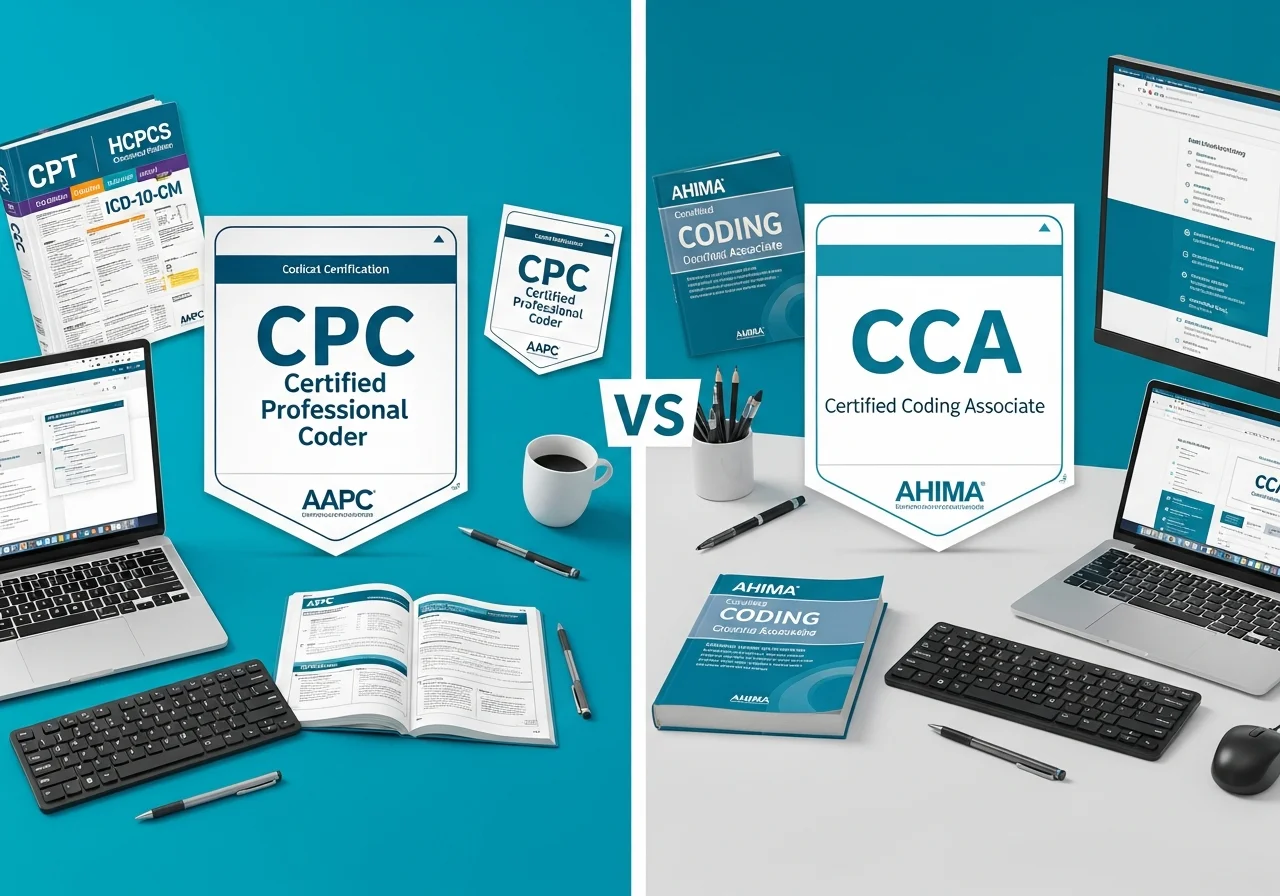
CPC vs CCA: Which Certification?
Comparing AAPC and AHIMA entry-level certifications: cost, difficulty, employer preference, and career impact.

Can AI Replace Medical Coders?
What automation means for medical coders: which tasks are changing and which skills remain essential.

Angela R.
Medical Billing & Coding Specialist | Consultant
Angela worked as a medical billing and coding specialist for multiple chiropractors and orthopedic surgeons. After years in the field, she started her own medical billing and coding consulting company, working with numerous clients throughout Southern California. She brings firsthand industry experience to every article on this site.