
Online medical billing and coding programs range from $1,049 (Penn Foster certificate) to $20,000+ (private associate degrees). Certificate programs take 4 to 15 months; associate degrees take about 2 years. Medical billing and coding classes online prepare you for the CPC, CCA, or CBCS certification exams, and most exams can be taken remotely through online proctoring. The BLS projects 7% job growth for medical records specialists through 2034 with 14,200 annual openings, and 64.8% of working coders already perform their jobs remotely.
- 1.Medical billing and coding online programs cost $1,049 (Penn Foster certificate) to $4,774 (average community college associate degree), well below most on-campus options.
- 2.The BLS projects 7% job growth for medical records specialists through 2034, with 14,200 annual openings. Online graduates compete on equal footing with campus graduates -- employers care about your certification, not where you studied.
- 3.Accreditation matters more than delivery format. Look for regional or national institutional accreditation recognized by the U.S. Department of Education. Programmatic accreditation from CAHIIM is a bonus.
- 4.Self-paced online programs can be completed in as little as 4 months. Cohort-based programs follow a fixed semester schedule of 9-15 months.
- 5.You can complete the entire path -- training through medical billing and coding certification online -- without visiting a physical campus. CPC, CCA, and CBCS exams all offer remote proctoring.
$1,049
Lowest Certificate Tuition
Penn Foster, 2025
4-15 mo
Certificate Timeline
Self-paced to cohort
64.8%
Coders Working Remote
AAPC 2025
$50,250
Median Salary
BLS, May 2024
Why Medical Billing and Coding Online Programs Work
Medical billing and coding is one of the most naturally suited healthcare fields for online education. The core work -- reviewing medical records, assigning diagnosis and procedure codes, managing insurance claims -- happens on a computer. Training follows the same pattern: you learn code sets (ICD-10-CM, CPT, HCPCS Level II), medical terminology, anatomy, and billing procedures through digital textbooks, video lectures, and practice coding exercises.
AAPC's 2025 salary survey reports that 64.8% of working medical records specialists now do their jobs remotely. That remote-friendly workplace has driven a shift in training: hundreds of accredited institutions offer fully online medical billing and coding programs at the certificate and associate degree level. Community colleges, vocational schools, national online providers, and universities all compete for students.
Source: Bureau of Labor Statistics
Types of Online Medical Billing and Coding Programs
Online certificate programs (4-15 months): These focus on billing and coding skills with no general education requirements. You'll cover ICD-10-CM, CPT, HCPCS Level II, medical terminology, anatomy basics, healthcare reimbursement, and HIPAA compliance. Certificates are the fastest and cheapest path into the field. Tuition ranges from about $1,000 to $5,000 at community colleges and $1,049 to $2,269 at national online providers (NCES, College Navigator).
Online associate degree programs (~2 years): These combine the billing and coding curriculum with general education courses (English, math, sciences). The broader education adds time and cost -- roughly $3,000 to $20,000+ depending on the institution -- but some employers (particularly hospitals) prefer degree holders. Associate degrees also give you a clearer path to advancement into health information management or supervisory roles.
Hybrid programs: A mix of online coursework and limited on-campus requirements, usually a practicum, lab session, or proctored exam. Less common for billing and coding than for clinical fields, but some community colleges offer in-person coding lab time alongside online lectures.
Online Program Cost Comparison
| Program Type | Typical Cost | Duration | Source |
|---|---|---|---|
| Penn Foster (Certificate) | $1,049-$1,869 | 4-12 months (self-paced) | Penn Foster 2025 tuition schedule |
| U.S. Career Institute (Certificate) | $1,869-$2,269 | 4-10 months (self-paced) | USCI 2025 tuition schedule |
| Community College (Certificate) | $1,000-$5,000 | 9-15 months (cohort) | NCES community college data |
| Community College (Associate) | $2,814-$4,774 | ~2 years | NCES, College Board Trends |
| Private/For-Profit (Certificate) | $5,000-$15,000+ | 9-15 months | Varies by institution |
| Private (Associate Degree) | $10,000-$20,000+ | ~2 years | Varies by institution |
What to Look For in an Online Program
Accreditation: This is the single most important factor. The institution should hold regional or national accreditation recognized by the U.S. Department of Education. Without it, the program may not qualify for federal financial aid, and some employers won't accept the credential. For health information programs specifically, programmatic accreditation from CAHIIM (Commission on Accreditation for Health Informatics and Information Management Education) signals a higher standard.
Certification exam prep: The program should state which exam it prepares you for -- typically the CPC (AAPC), CCA (AHIMA), or CBCS (NHA). Ask about exam pass rates if available. Programs that include practice exams and timed coding simulations prepare you better than lecture-only formats.
Instructor access: Online doesn't have to mean isolated. Look for programs offering live virtual office hours, discussion forums with instructor participation, and responsive email or chat support. Student-to-instructor ratios matter just as much online as in a classroom.
Source: Penn Foster 2025 tuition schedule
How to Evaluate an Online Program (5-Step Checklist)
Verify accreditation
Check the U.S. Department of Education's database (ope.ed.gov) to confirm the institution holds recognized accreditation. No accreditation = no federal financial aid and potential employer skepticism.
Confirm certification exam alignment
Ask which exam the program prepares you for (CPC, CCA, or CBCS). Check if the exam fee is bundled into tuition -- some programs include a voucher.
Ask about hands-on practice
Find out if the program includes a practicum, virtual externship, or access to AAPC's Practicode tool (500+ real coding cases). Pure lecture-based programs leave a gap in practical skills.
Compare total cost (not just tuition)
Factor in textbooks, code books (updated annually), technology fees, exam fees, and any required on-campus visits. Some programs bundle everything; others don't.
Check completion and job placement rates
Accredited programs should publish completion rates. Ask about job placement data for graduates. If a school can't or won't share these numbers, that's a red flag.
Self-Paced vs Cohort-Based Online Programs
Self-paced programs give you access to all course materials from day one. You move through topics at your own speed -- fast through areas you already know, slower where you need more practice. Penn Foster and U.S. Career Institute use this model. The advantage is flexibility: you can study evenings and weekends around a full-time job. The trade-off is that without external deadlines, completion rates tend to be lower.
Cohort-based programs follow a fixed academic calendar with set start dates, weekly deadlines, and a defined end date. Most community college medical billing and coding classes online use this format. You move through material with classmates, which creates accountability and peer interaction. The trade-off is less flexibility -- miss a deadline and you may need to wait until next semester.
Neither is better across the board. If you're self-motivated and need scheduling flexibility, self-paced works. If you benefit from structure and deadlines, cohort-based is more effective.
Online Programs
Flexible, lower cost, mirrors remote work
In-Person Programs
Structured, hands-on labs, local networking
Practicum and Externship Requirements
Some online medical billing and coding programs require a practicum or externship -- supervised coding work at a healthcare facility or billing company. This creates a logistical issue for fully online students: you need a local placement site, which the school may or may not help arrange.
Before enrolling, ask the program directly: Does it include a practicum? How many hours? Does the school help find placement sites? Can you complete it virtually using de-identified medical records? Is AAPC's Practicode accepted as a substitute?
Programs without any hands-on component aren't automatically disqualifying, but you'll need to supplement your training. AAPC's Practicode provides 500+ real-world coding cases. AHIMA offers practice resources for members. Coding textbooks with case studies can partially fill the gap. Our step-by-step career guide covers strategies for building practical experience before your first job.
Source: AAPC 2025 Salary Survey
Your Next Steps
Decide: certificate or associate degree
If your goal is to start working quickly, a certificate (4-15 months, $1,049-$5,000) gets you there. If you want a degree for long-term advancement or employer preference, budget ~2 years for an associate degree.
Research 3-5 accredited programs
Compare tuition, certification exam alignment, practicum requirements, and completion rates. Use the checklist above. Don't just pick the cheapest -- pick the one that prepares you to pass the exam.
Check your financial aid options
Accredited programs qualify for federal student aid (FAFSA). Some also accept state grants, scholarships, or employer tuition assistance. See our financial aid guide for details.
Pick a target certification
CPC (AAPC) is the most recognized coding credential ($425-$499 exam). CCA (AHIMA) has a lower barrier ($199-$299). CBCS (NHA) covers both billing and coding at ~$117. See our certification comparison to decide.
Enroll and set a study schedule
Self-paced students should block study time on their calendar just like a class. Aim for 10-15 hours per week to finish a certificate in 6-9 months. Set a target exam date to stay motivated.
Frequently Asked Questions
Related Guides
Latest Articles

Medical Billing and Coding Industry Trends 2026
AI-assisted coding, value-based care, and remote work are reshaping the medical coding profession.
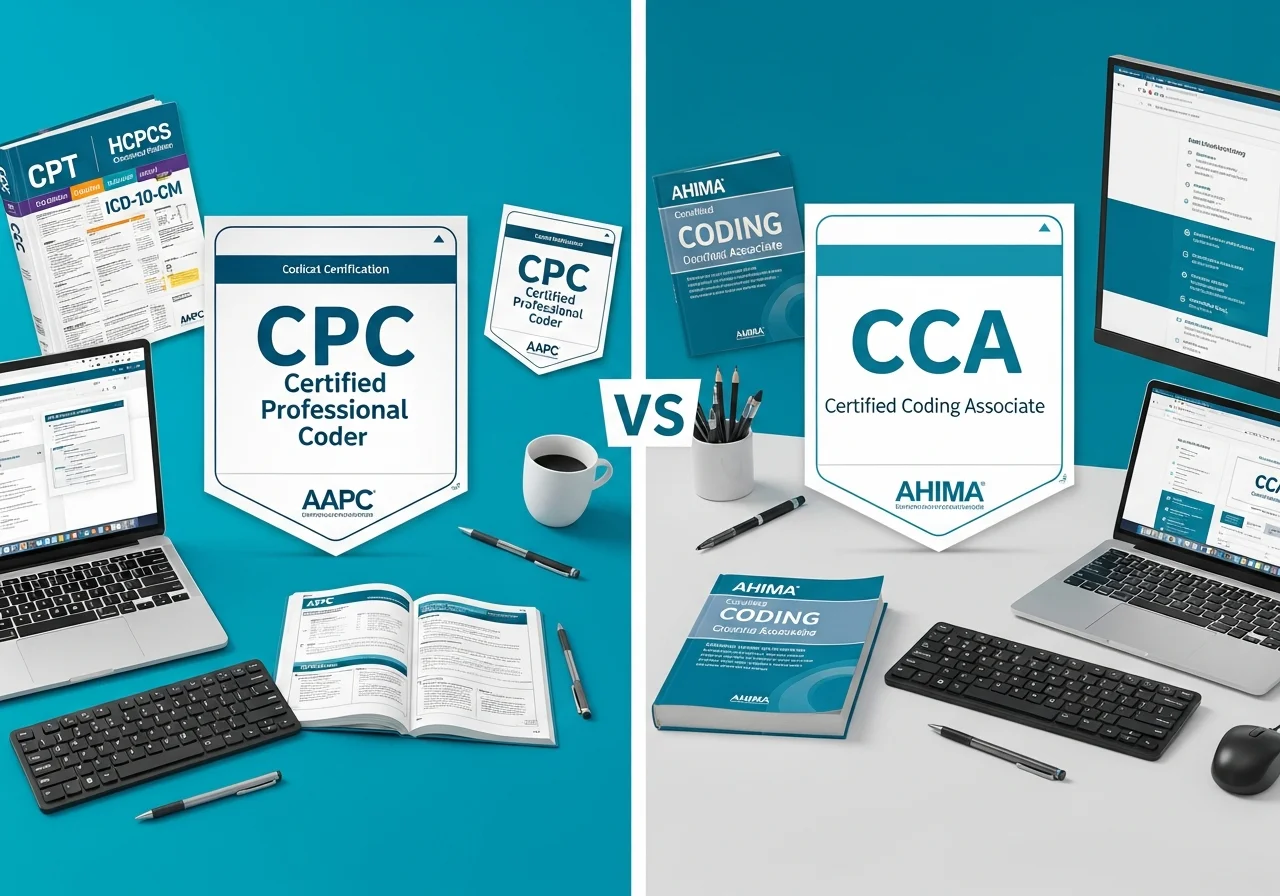
CPC vs CCA: Which Certification?
Comparing AAPC and AHIMA entry-level certifications: cost, difficulty, employer preference, and career impact.

Can AI Replace Medical Coders?
What automation means for medical coders: which tasks are changing and which skills remain essential.

Angela R.
Medical Billing & Coding Specialist | Consultant
Angela worked as a medical billing and coding specialist for multiple chiropractors and orthopedic surgeons. After years in the field, she started her own medical billing and coding consulting company, working with numerous clients throughout Southern California. She brings firsthand industry experience to every article on this site.