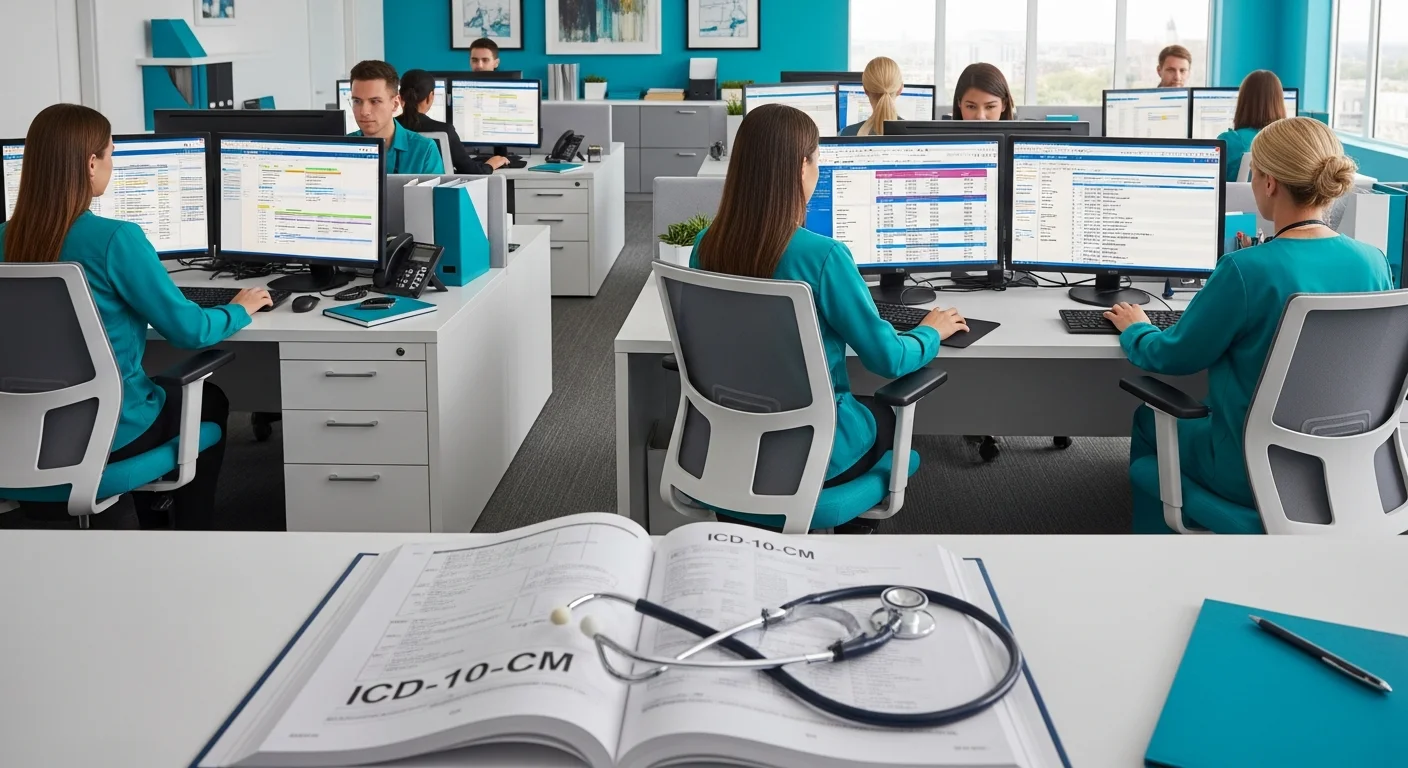
Medical billing and coding is a healthcare career where professionals translate clinical documentation into standardized codes (ICD-10, CPT, HCPCS) and use those codes to bill insurance companies. The BLS classifies both roles under Medical Records Specialists (SOC 29-2072), reporting a median salary of $50,250/yr, 7% job growth through 2034, and roughly 14,200 annual openings. About 65% of coders now work remotely.
- 1.Medical coding translates diagnoses, procedures, and equipment into standardized alphanumeric codes (ICD-10, CPT, HCPCS) so providers, insurers, and government agencies share a common language.
- 2.Medical billing takes those codes and turns them into insurance claims, follows up on payments, manages denials, and collects patient balances.
- 3.The BLS classifies both roles under "Medical Records Specialists" (SOC 29-2072), reporting a median salary of $50,250/yr and 7% job growth from 2024 to 2034.
- 4.Many professionals handle both billing and coding, but larger organizations separate them into distinct positions with specialized teams.
- 5.About 64.8% of medical coders now work remotely full time (AAPC 2025), making this one of the most remote-friendly roles in healthcare.
$50,250
Median Salary
194,800
U.S. Jobs
7%
Growth (2024-2034)
64.8%
Work Remotely
Medical Billing and Coding at a Glance
So what is medical billing and coding? It's the process that turns a patient's doctor visit into a paid insurance claim. Every time you see a healthcare provider, someone has to document what happened, assign the right codes to each diagnosis and procedure, and then send a claim to your insurance company for payment. That's medical billing and coding in a sentence.
The field splits into two connected but distinct functions. Medical coding is the translation work: reading clinical documentation and converting it into standardized codes. Medical billing is the financial work: assembling those codes into claims, submitting them, and following the money until the provider gets paid. Some professionals do both. Others specialize in one or the other.
The BLS groups both roles under "Medical Records Specialists" (SOC 29-2072). As of May 2024, there are 194,800 jobs in the U.S., the median salary is $50,250/yr, and employment is projected to grow 7% through 2034, with about 14,200 openings per year (BLS Occupational Outlook Handbook).
Reviewing clinical documentation (physician notes, lab results, operative records) and translating each diagnosis and procedure into standardized ICD-10, CPT, and HCPCS codes.
Key Points
- ICD-10-CM proficiency
- CPT code assignment
- Medical terminology
- Anatomy knowledge
Common Jobs
- • Medical Coder
- • Inpatient Coder
- • Coding Auditor
- • HCC/Risk Adjustment Coder
Assembling coded claims, submitting them to insurance payers, tracking payments, managing denials and appeals, and collecting patient balances.
Key Points
- Claims submission
- Denial management
- Insurance verification
- Revenue cycle knowledge
Common Jobs
- • Medical Biller
- • Claims Specialist
- • Billing Manager
- • Revenue Cycle Analyst
Handles both coding and billing from start to finish. Common in small practices and outpatient clinics where one person manages the full revenue cycle.
Key Points
- Full-cycle billing
- Multi-specialty coding
- Patient collections
- EHR navigation
Common Jobs
- • Medical Biller and Coder
- • Office Billing Coordinator
- • Practice Manager
What Is Medical Coding?
Medical coding is the process of reviewing clinical documentation and translating each diagnosis, procedure, and piece of medical equipment into a standardized code. These codes form the backbone of healthcare data. They tell insurers what happened during a patient visit, feed public health databases, and help hospitals track outcomes.
Coders work with three primary code sets. ICD-10-CM covers diagnoses (roughly 72,000 codes). CPT describes medical services and procedures (about 10,000 codes). HCPCS Level II adds codes for items like durable medical equipment, prosthetics, and ambulance services that CPT doesn't cover. We'll break down each system in detail below.
Accuracy is everything. An incorrect code can trigger a claim denial, delay payment by weeks, or raise compliance red flags. Coders follow the rule of "coding to the highest degree of specificity," meaning they capture the most precise diagnosis and procedure information the documentation supports. No more, no less.
Source: CMS / WHO ICD-10 Classification
What Is Medical Billing?
Medical billing picks up where coding leaves off. Once the codes are assigned, a biller assembles the insurance claim. This is a structured electronic document (typically an 837P for professional services or 837I for institutional claims) that tells the payer what services were rendered, why they were medically necessary, and how much the provider expects to be reimbursed.
The billing cycle has several stages. Before a visit, billers verify insurance eligibility and obtain prior authorizations. After the visit, they review coded charges for accuracy, submit claims through a clearinghouse, and monitor each claim's status. When a payer denies a claim or requests more information, the biller investigates, corrects errors, and resubmits. They also generate patient statements for any remaining balance and set up payment plans.
Revenue cycle management (RCM) is the industry term for this end-to-end process. A skilled biller keeps the cycle moving, reducing "days in accounts receivable," one of the key financial metrics healthcare organizations track.
Medical Coding
Clinical documentation to codes
Medical Billing
Codes to insurance payment
Billing vs. Coding: Key Differences
The table above captures the core differences, but here's the practical version. Coders spend their day reading clinical documentation and choosing codes. Their mistakes trigger denials and compliance problems. Billers spend their day managing money: submitting claims, chasing payments, and resolving denials. Their mistakes mean the provider doesn't get paid.
In small practices, one person does both. In hospitals and large health systems, they're separate departments with specialized teams for inpatient coding, outpatient coding, charge capture, claims follow-up, and payment posting. If you're deciding between the two, coders tend to prefer detail-oriented analytical work, while billers tend to prefer financial problem-solving and communication. For a deeper breakdown, see our billing vs. coding comparison.
Source: BLS Occupational Outlook Handbook, 2024
The Three Code Systems Explained
ICD-10-CM / ICD-10-PCS. ICD-10-CM handles diagnosis coding across all healthcare settings. ICD-10-PCS handles inpatient procedure coding exclusively. Together, they contain over 72,000 diagnosis codes and roughly 78,000 procedure codes. The World Health Organization maintains the underlying ICD framework. The U.S. version is adapted by CMS and the National Center for Health Statistics (NCHS).
CPT (Current Procedural Terminology). Published annually by the American Medical Association, CPT codes describe medical, surgical, and diagnostic services. Category I covers standard procedures (the codes billers and coders use most). Category II covers supplemental tracking codes for performance measurement. Category III covers emerging technology and temporary codes.
HCPCS Level II. Maintained by CMS, these alphanumeric codes (a letter followed by four digits) capture supplies, equipment, and non-physician services that CPT doesn't cover. Think wheelchair accessories, orthotic devices, and certain drugs administered in a physician's office.
Source: BLS OEWS, May 2024 (SOC 29-2072)
A Day in the Life
A typical day for a medical coder starts with a queue of patient encounters waiting for codes. You open each electronic health record, read the provider's documentation, identify all reportable diagnoses and procedures, and assign the right ICD-10, CPT, and HCPCS codes. When documentation is unclear, you submit a query to the provider asking for clarification. That step protects both accuracy and compliance.
Medical billers, meanwhile, manage the claims pipeline. Mornings might involve reviewing the previous day's coded encounters, batching claims for submission, and checking clearinghouse reports for rejected transmissions. Afternoons often focus on denial management: reading Explanation of Benefits (EOB) documents, identifying denial patterns, and preparing appeals. Patient-facing tasks (answering billing questions, explaining coverage, arranging payment plans) fill the gaps.
In a small practice, you'll handle all of it. In a hospital, you'll specialize. Either way, the work is detail-heavy, screen-based, and deadline-driven.
Skills You'll Need
Technical Skills
72,000+ diagnosis codes used in every healthcare setting
10,000 procedure codes for medical services
Epic, Cerner, and other electronic health record systems
Understanding anatomy, physiology, and clinical language
Soft Skills
One wrong digit can deny a claim or trigger an audit
Most coders have daily productivity targets
Querying physicians, explaining billing to patients
Where Billers and Coders Work
The BLS reports that the largest employers of medical records specialists are hospitals (28% of jobs), physician offices (22%), and administrative/support services (11%). Other common settings include outpatient care centers, nursing facilities, and insurance carriers.
Remote work has reshaped the field. AAPC's 2025 salary survey reports that 64.8% of coders work remotely full time, a number that jumped during the pandemic and hasn't come back down. This makes medical coding one of the most remote-friendly careers in healthcare. Most remote positions require at least 1-2 years of on-site experience first, though some employers now hire entry-level remote coders.
Third-party billing companies and revenue cycle management (RCM) firms employ large numbers of billers and coders, handling claims for multiple providers under one roof. Government agencies, including the VA, DoD, and state Medicaid offices, are another significant employer and tend to offer higher-than-average pay.
How to Get Started in Medical Billing and Coding
Complete a training program
Choose a certificate program (4-15 months) or associate degree (~2 years). Both can lead to the same entry-level jobs. Community college programs cost $1,000-$5,000 for certificates. See our guide on program costs.
Earn a professional certification
The CPC (AAPC) and CCA (AHIMA) are the two most recognized entry-level credentials. Certified professionals earn 20.7% more than non-certified workers (AAPC 2025). See our certification comparison.
Gain hands-on experience
Many programs include practicum hours. AAPC also offers an apprentice designation (CPC-A) for new coders who pass the exam but haven't completed the experience requirement.
Apply for your first position
Target physician offices, outpatient clinics, and RCM companies for entry-level roles. Hospitals typically prefer 1-2 years of experience. Remote positions are available but competitive for new coders.
Frequently Asked Questions
Related Guides
Latest Articles

Medical Billing and Coding Industry Trends 2026
AI-assisted coding, value-based care, and remote work are reshaping the medical coding profession.
CPC vs CCA: Which Certification?
Comparing AAPC and AHIMA entry-level certifications: cost, difficulty, employer preference, and career impact.

Can AI Replace Medical Coders?
What automation means for medical coders: which tasks are changing and which skills remain essential.

Angela R.
Medical Billing & Coding Specialist | Consultant
Angela worked as a medical billing and coding specialist for multiple chiropractors and orthopedic surgeons. After years in the field, she started her own medical billing and coding consulting company, working with numerous clients throughout Southern California. She brings firsthand industry experience to every article on this site.